Many Toronto Blue Jays players have received criticism amid the team’s 45-51 start, but no individual has gotten more than Vladimir Guerrero Jr.
There are several reasons for that, ranging from offensive issues up and down the lineup that magnify his struggles, his hefty long-term contract and massive expectations following his post-season dominance last year. One of the key ingredients to the animus over Guerrero's performance is that it feels inexplicable.
At 27, Guerrero should be right in the middle of his prime. He excelled in spring training and at the World Baseball Classic, suggesting that he’d hit the ground running in 2026. Even during his rough start, many of the core elements of his strong offensive profile remained intact, like excellent bat speed, a low strikeout rate and a high walk rate. A 99 wRC+ over any length of time shouldn’t be in the cards, and his putrid June (37 wRC+) felt below the floor of his capabilities.
Guerrero's power has simply deserted him. Of the 149 qualified hitters in the majors, just nine have a lower ISO than Guerrero, and only 15 have hit fewer than his six home runs. That’s unfathomable stuff for a guy who’s been a middle-of-the-lineup force for most of his career.
Several explanations have been offered for this power outage, none of which seem provable. Maybe the weight of expectations is too much. Perhaps the absence of Bo Bichette, or just other reliable producers, has a tangible effect. The mental load of Guerrero's slump may have given it self-perpetuating properties. The difficulty he’s had with his back may have been understated for most of the season.
It doesn’t seem possible to confidently support any claim about what’s going on with Guerrero, and it's undoubtedly a messy confluence of many things. Instead of trying to get to the bottom of the mystery, we’re going to try and figure out how big a mystery it is. Baseball is an odd sport where player performance fluctuates pretty significantly, and even a whole half-season can be a small sample size. Guerrero's first half might seem calamitous, but maybe there are other similar cases out there of stars having bizarre underperformance to start a season.
To find out, we’ll look at players who are most historically similar to Vladdy overall, to see if they ever crashed and burned out of the gate at 27 and whether there’s a pattern of MLB’s best playoff performers having letdowns after legendary post-season runs.
Historical comparables
One of the reasons the Blue Jays opted to build around Guerrero is that he’s achieved an extremely rare level of MLB success for his age. That doesn’t mean there aren’t similar hitters in the long history of the majors.
Guerrero entered 2026 as just one of 60 players since 1900 with a track record including 4,000 MLB plate appearances before his age-27 season. Because wRC+ is a metric pegged to league averages, it works well across MLB eras and is a good way to find historical comparables within that group.
If we take players with 4,000 plate appearances through age 26 and a wRC+ within 10 points of Guerrero's 137, we get a list that looks like this:
• Joe Medwick (146 wRC+)
• Alex Rodriguez (143 wRC+)
• Ken Griffey Jr. (142 wRC+)
• Orlando Cepeda (140 wRC+)
• Sherry Magee (139 wRC+)
• Rickey Henderson (138 wRC+)
• Miguel Cabrera (138 wRC+)
• Bryce Harper (138 wRC+)
• Sam Crawford (133 wRC+)
• Cesar Cedeno (130 wRC+)
• Al Kaline (128 wRC+)
• Ron Santo (128 wRC+)
• Johnny Bench (128 wRC+)
That is impressive company with eight Hall of Famers out of the 13 — not including Rodriguez, whose statistics are among the best in MLB history, but who was excluded for PED use. There are also two likely candidates in Cabrera and Harper.
In that group who entered their age-27 seasons with similar offensive track records to Guerrero, the question is whether any faceplanted like Vladdy. To answer that, we’re going to use OPS because of a lack of sophistication in publicly available first/second half splits before 2002.
However, this time we’re measuring players against themselves rather than across eras to determine how similar they are to Guerrero, meaning we’ll get a good idea of how they fared compared to their existing standards.
Cepeda has been removed because he only took 40 trips to the plate in his age-27 season due to injuries.
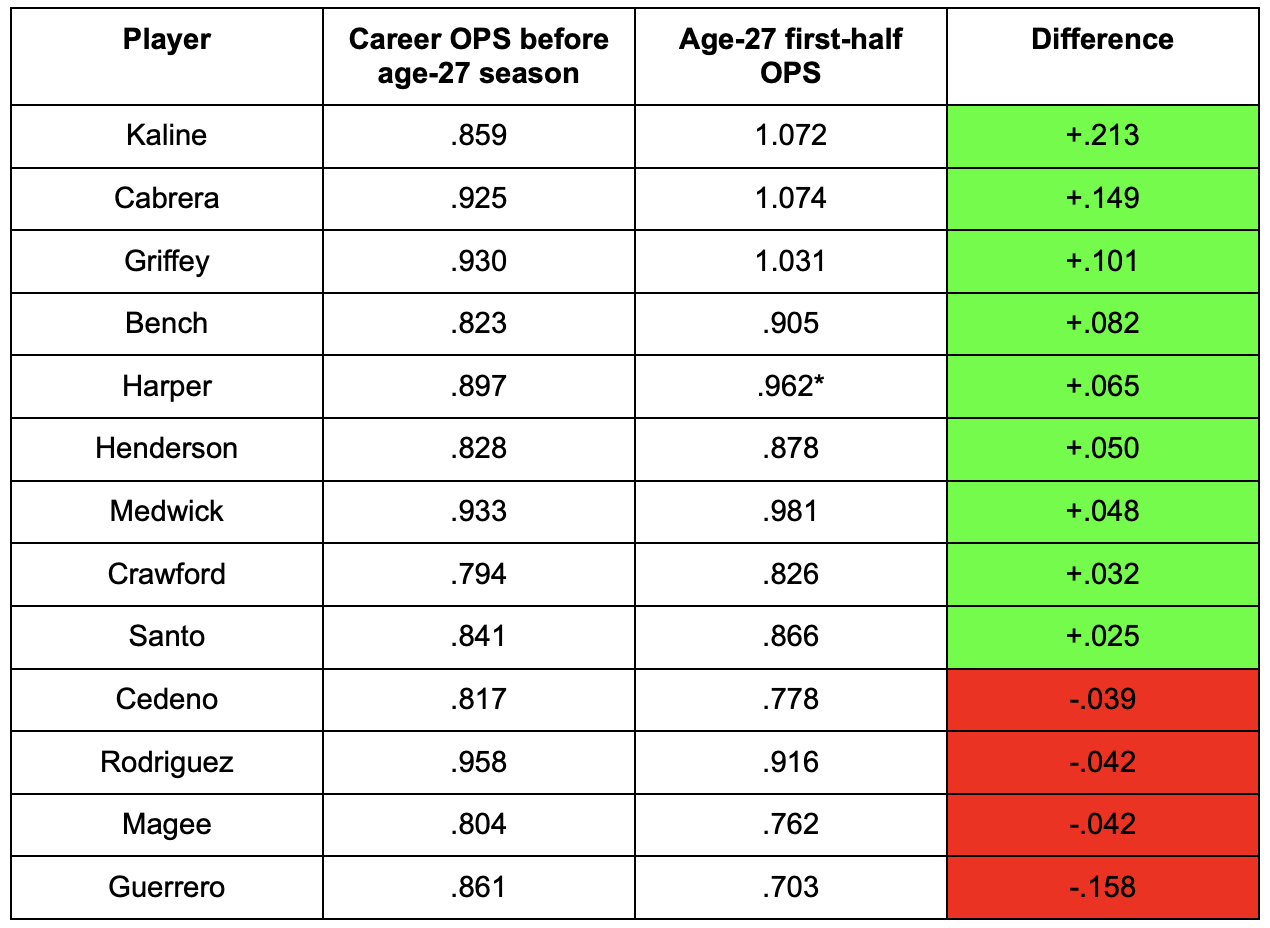
Guerrero is an outlier among his historical peers. Some players were similarly far from their baselines in the first half of their age-27 seasons, but none of them underperformed anywhere nearly as much as Guerrero.
Dealing with a group of mostly Hall of Famers during their physical primes, this should not be a surprise, but it helps contextualize how unusual Guerrero’s 2026 has been. Across various eras, players with track records like the Blue Jays first baseman just don’t tend to falter at this point in their careers.
Playoff heroes
Finding players coming off similar playoff runs to Guerrero’s 2025 is more difficult than identifying overall historical comps, because it was nearly unprecedented. The slugger’s 241 playoff wRC+ last season was the best in MLB history for a single playoff run with 50 or more plate appearances.
Because we went with 13 player comparables in the last section, we’ll replicate that number and use the players with the 13 best wRC+ numbers that sit behind Guerrero on the list — besides Addison Barger, who had his first half this season obliterated by injuries. We’ll also use OPS again to accommodate players from a previous era (Griffey and Javy Lopez) and see if the results look similar.
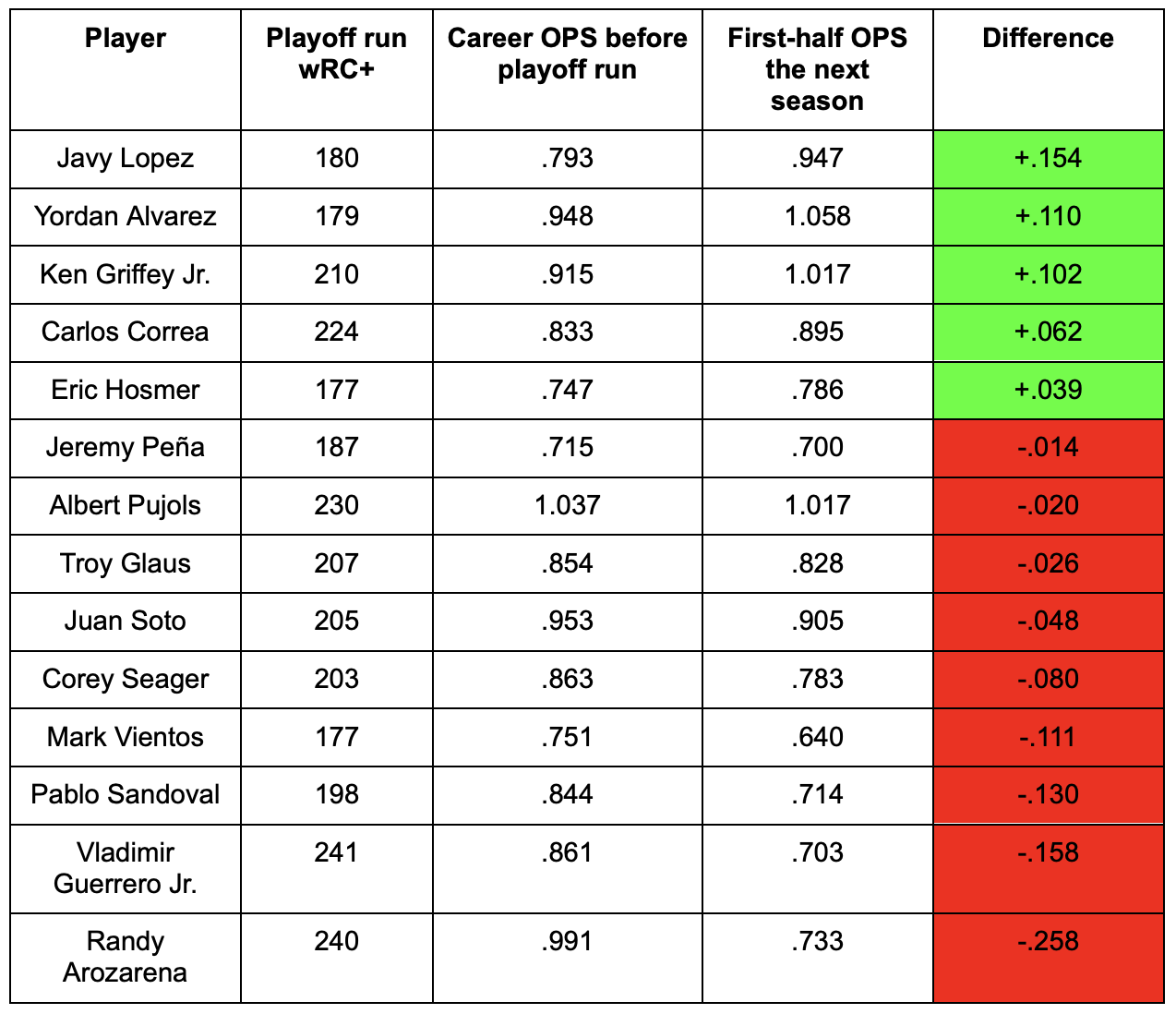
Looking at these players coming off special playoff runs, it seems like there are more Guerrero-like cases out there, but most can be dismissed upon closer inspection. Arozarena had only taken 99 plate appearances in the majors before his incredible run in the 2020 postseason and hadn’t established a fair baseline. Similarly, Vientos entered the 2024 playoffs with just one full season under his belt.
That leaves Sandoval as the most intriguing name, and one that Blue Jays fans won’t be keen to hear given the way his production fell off a cliff in his late 20s. It’s noteworthy that following his stellar 2012 playoff run, he scuffled initially but posted a 133 wRC+ in the second half of 2013. He finished the season with overall numbers that closely matched the previous season (he had a 118 wRC+ in 2012 and a 117 in 2013). The next season he posted a 110 wRC+ and slashed an excellent .366/.423/.465 in the playoffs. The early 2013 wobble was not the beginning of Sandoval going from beloved star and multiple-time champion to cautionary tale.
This group overall is muddier because it includes a combination of stars comparable to Guerrero in offensive skill and solid offensive contributors. There is a slight trend towards early struggles the season after a legendary playoff performance, but not enough of one to offer much insight on Guerrero.
What all of this shows is that the Blue Jays first baseman is experiencing the kind of performance that just isn’t seen by players of his calibre — or those who conjured a playoff run like his unbelievable 2025.
Even in a volatile game like baseball, where statistics can take a fiendishly long time to reflect reality, and both positive and negative mirages are ubiquitous, a half like the one Guerrero just experienced is a significant mystery.


 1:38
1:38