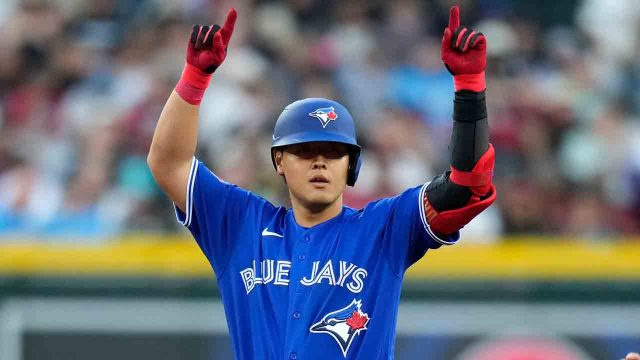
TORONTO — When the Blue Jays hosted the Los Angeles Dodgers for a three-game set at Rogers Centre in April, there was specific signage behind home plate.
As Shohei Ohtani stepped into the batter’s box against Max Scherzer to open the first contest of the World Series rematch, a Destination Ontario advertisement featuring Japanese lettering invited viewers to the province.
The next day, WestJet, the Canadian airline that offers flights to Tokyo, featured prominently while Ohtani led off against Kevin Gausman.
It was Honda’s turn in the finale, with the Japanese automaker’s logo appearing on the screen as Ohtani dug in to face Dylan Cease.
These placements weren’t coincidental. Each game of the Dodgers-Blue Jays series was aired by Japan’s public broadcaster NHK, the rights holder to MLB games in that country, and so a different, wider audience prompted the targeted strategy.
While the Japanese-related signage in the stadium was rather subtle, the Blue Jays’ long-term goal is to change that. And with third baseman Kazuma Okamoto now in the fold as a core piece after signing a four-year, $60-million deal in January, there’s never been a better time for the organization to make serious inroads into the Japanese business market.
The Blue Jays intensely pursued Ohtani nearly three years ago in part because he’s essentially a business in and of himself with an impressive collection of endorsement deals. There’s simply no other player in the sport with his reach.
“We did have a strong business case to make when we put that proposal forward (to ownership),” Blue Jays president Mark Shapiro said during his pre-season media availability in March. “Like, here’s what we think the direct impact would be on ticket sales, on corporate partnerships, on opportunities in Japan.”
However, the reasons behind the signing of Okamoto, a star slugger for the Yomiuri Giants, were different.
“It was truly just a talent evaluation,” said Shapiro. “We didn't factor in at all any opportunity for incremental business growth.”
MLB clubs are open to sharing information about such off-field subjects, and so, after inking Okamoto, the Blue Jays had conversations with the Dodgers and Chicago Cubs about their respective business ventures in Japan. The Cubs were especially interesting because their Japanese players, outfielder Seiya Suzuki and left-hander Shota Imanaga, are of similar stature to Okamoto in their home country.
The Cubs began to make a concerted effort to grow their brand in the Japanese marketplace after signing Suzuki in 2022, but it wasn’t until the addition of fellow Nippon Professional Baseball star Imanaga in 2024 that a more comprehensive strategy developed, according to Alex Seyferth, senior vice president of corporate partnerships.
Imanaga burst onto the scene with immediate success, and NHK began to broadcast the games he started. That meant more exposure for the Cubs, and, in turn, the organization signed Japanese manufacturer THK to a sponsorship agreement that included a billboard ad at Wrigley Field.
Seyferth and his team quickly learned that making a business deal in Japan was not the same as in the United States.
“The most important thing was showing up and being there,” Seyferth said, adding that there are “cultural differences in how to approach business” and establish trust.
In-person meetings are seen as a form of deep respect and are vital to building relationships in Japan. The Cubs embraced that, and members of their partnership team began to make quarterly trips to Tokyo. As well, the organization invited potential clients to Wrigley so they could take in the game day experience at the historic ballpark.
“A lot of the partners that we've had from Japan are baseball lovers and showing our brand of baseball, what makes Wrigley so special, and how it differs from their past experiences, was just a really nice thing to do,” said Seyferth.
As they gained a greater understanding of the market, the Cubs began to reel in more Japanese sponsors and now boast a portfolio of eight significant partners, including Daiso, Fujikara, Hi-Chew and Kinoshita Group.
The Cubs essentially sell different forms of visibility to those companies, with partnerships including anything from broadcast exposure to ballpark signage, activations and hospitality assets.
Success in the Japanese market didn’t arrive immediately, stresses Seyferth.
“Sponsorship generally lags behind other kinds of business metrics,” he said. “We signed Seiya in 2022, Shota in 2024, but 2025 was when we really saw an uptick … and experienced the first significant bump.”
Seyferth notes the Cubs’ inclusion in MLB’s Tokyo Series against the Dodgers last year was an important ingredient. Simply put, it’s easier to attract sponsors when you’re playing games in their backyard. It’s as if the team’s PowerPoint presentations were brought to life.
MLB officials are aware of the Blue Jays’ interest in participating in a future Tokyo Series. However, a challenge for the club is that those decisions are driven by broadcast interests, and the Blue Jays are competing in a pool of teams that carry massive international appeal.
There’s hope within the organization, though, that it stands to benefit from a profile that was enlarged by a captivating run to the World Series.
In the meantime, the Blue Jays are still in the early phase of charting their path forward in Japan, not unlike where the Cubs were a few years ago. The team hasn’t yet hosted any potential Japanese clients at Rogers Centre, and it hasn’t sent any officials to Tokyo for business meetings, though the expectation is that Shapiro and Marnie Starkman, executive vice president of business operations, will likely make the trip at some point.
Okamoto, meanwhile, is doing his part on the field. The 29-year-old has been the Blue Jays’ best position player this season, and if that continues, the club can expect more of their games to be broadcast in Japan.
Before airing the series against the Dodgers, NHK picked up two games from the Blue Jays’ season-opening weekend against the Athletics. The sponsorship element was modest during those contests, but if everything goes according to plan, it won’t stay that way.
“It's going to take time to build relationships,” said Shapiro. “It's going to take time to have [Okamoto] adjust here and impact here and have people [in Japan] see his impact in this market and understand our market even more.
“It's not something that's immediate.”




 0:56
0:56 0:43
0:43