The Toronto Blue Jays’ now-failed playoff push began around the trade deadline, but it wasn’t necessarily what the team had in mind when it was wheeling and dealing in early August.
Toronto left the door open for a late-season surge by acquiring players it knew it could use immediately in José Soriano, Josh Smith and Spencer Arrighetti, and holding onto players on expiring contracts like George Springer and Shane Bieber. At the same time, it entered deadline day with 4.4 per cent playoff odds — according to FanGraphs — and dealt with an eye to the future. The aim of making an improbable post-season run has fallen by the wayside, but the primary goal of strengthening the team for the future remains in play. Nearly two months of high-stakes games have provided valuable information about the likelihood of the Blue Jays’ deals paying off longer term.
A closer look at the first impressions of the team’s acquisitions includes both reasons for optimism and some early disappointments.
José Soriano
Numbers as a Blue Jay: 7.01 K/9, 2.81 BB/9, 0.88 HR/9 in 51.1 IP with a 4.73 ERA, 4.35 xERA and 4.03 FIP.
Prognosis for 2027 and beyond: Soriano came to Toronto with a reputation for inconsistency, and he lived up to it in his first nine starts as a Blue Jay. In the past, losing the strike zone was the most common way things went awry for the right-hander, but in Toronto, balls in play hurt him.
While the Blue Jays had him up his sinker rate and focus on groundballs, his difficulty finishing off hitters hurt him consistently. Although the quality of contact he allowed didn’t get more dangerous, the jump in quantity was an issue, pushing his hits/9 allowed from 7.1 with the Los Angeles Angels to 8.8 with the Blue Jays.
Toronto likely wanted to see more from their top deadline acquisition, but zooming out a bit, Soriano has still been one of the better starters in the game since the beginning of 2025, ranking 18th in innings pitched (343.1) and 30th in fWAR (5.4) in the majors over the last two seasons. A slightly disappointing nine-start stretch shouldn’t cause a great deal of alarm, even if the Blue Jays could’ve reasonably hoped for more.
When Soriano was acquired, there was speculation that he could take a step forward heading from an organization with a dismal reputation for handling pitchers to one that has done well helping veteran arms improve. That idea has not been validated yet, but the early results aren’t disappointing enough that it can be ruled out already.
Numbers as a Blue Jay: .320/.394/.413 line in 172 plate appearances with two HR, three SB and a 133 wRC+.
Prognosis for 2027 and beyond: When Bateman joined the Blue Jays, he seemed likely to get a taste of MLB action in 2026, but it was unclear how big an opportunity he’d get and how well he’d perform.
He made his MLB debut less than a week after Toronto acquired him, was elevated to the second spot in the lineup in his second appearance, a spot he didn’t drop below from that point on. From August 14 on, he was the Blue Jays’ leadoff hitter in every game he played, cementing himself as the team’s full-time centre fielder. From his debut on, his 1.7 fWAR ranks 20th in the majors among all position players, and his 133 wRC+ tops the rookie leaderboard.
All of that is to say, Bateman quickly seized a massive opportunity and ran with it. Heading into 2027, it would be shocking if he wasn’t on the Blue Jays roster, and while it’s no guarantee he’ll be the Opening Day centre fielder, that would be a credible direction for the team to take. That’s a lot of progress for a guy — particularly a relatively unheralded prospect who many saw as a future bench player — to make in a couple of months.
Bateman’s stellar finish to 2026 doesn’t guarantee he’ll be a long-term star, or even an everyday player. It’s still valid to wonder if a strikeout rate that has hovered around 20 per cent in the majors and low minors is high for a pure contact hitter, or if he can keep drawing walks without presenting much of an extra-base threat. It’s also notable that his expected batting average (.260) and slugging percentage (.330) are far lower than his actual production — even if his speed should allow him to overperform his contact quality a bit in most seasons.
There are holes to poke and cautionary tales to tell about players who fizzled after hot debuts. Even with that in mind, Bateman was undeniably impressive. His combination of speed and defence also means that he won’t need to be as effective a hitter as he’s been this down the stretch to be a valuable major leaguer. In most cases, less than two months after acquiring a prospect at the trade deadline, you can’t be 100 per cent confident they’ll ever help your squad at the big-league level. Bateman already has, and looks like a good bet to continue contributing for years to come.
Josh Smith
Numbers as a Blue Jay: .188/.288/.420 line in 82 plate appearances with five HR, one SB and a 98 wRC+.
Prognosis for 2027 and beyond: Smith’s final stretch for Toronto is a puzzling one.
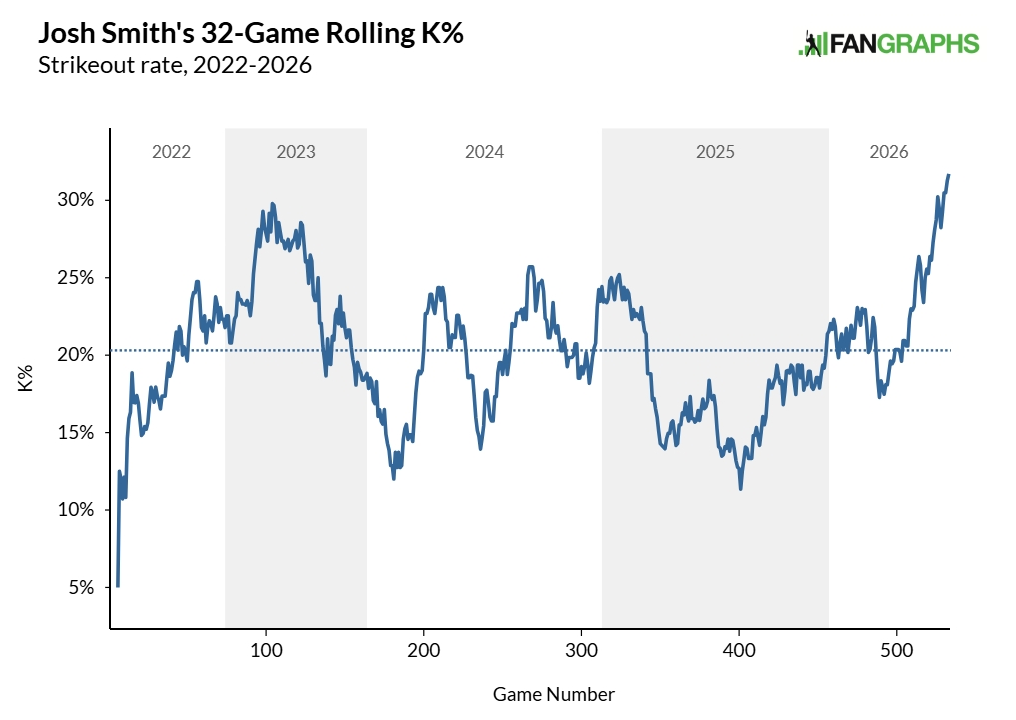
His overall offensive performance ticked up to near-average after massive struggles with the Texas Rangers earlier in the year; he showed admirable power, and he filled in at spots like left field and second base where the Blue Jays struggled to get production. On the other hand, neither his bat speed nor exit velocity improved in a way that suggested his power had meaningfully changed, and his 32 games with Toronto included the highest strikeout rate he’d ever posted over a stretch of appearances that long.
Smith is unlikely to get much of a raise through arbitration from his 2026 number ($3.23 million) after a rough season overall, he was an above-average hitter in 2024 and 2025, and he brings significant defensive versatility. He’ll also enter 2027 with multiple minor-league options. That package of characteristics gives him a good chance to stick around. The range of outcomes for his role is fairly large. He could be anything from a super-utility player who appears in 100-plus games to Triple-A insurance. His finishing stretch with the Blue Jays doesn’t completely clarify his fate with the team, but it helps suggest he has more to offer than the meagre production he gave the Rangers at the beginning of 2026.
Spencer Arrighetti
Numbers as a Blue Jay: 7.54 K/9, 5.56 BB/9, 2.38 HR/9 in 22.2 IP with a 6.35 ERA, 5.80 xERA, and 6.85 FIP.
Prognosis for 2027 and beyond: There aren’t any meaningful positives that can be drawn from Arrighetti’s first appearances in a Blue Jays uniform. He didn’t miss bats, hit the strike zone or allow hard contact. It’s possible that pitching through a nerve condition known as Morton’s neuroma hampered him significantly, but even if that’s the case, his performance didn’t inspire confidence.
The good news for Toronto is that the bar for Arrighetti to be helpful to the team is low. Higher than what he showed this year, but low nonetheless. The right-hander’s greatest appeal coming over from the Houston Astros was his status as a rare starter with meaningful MLB experience (52 career starts before the trade) and multiple minor-league options. Arrighetti’s ideal role is as a sixth, or even seventh starter whose presence at Triple-A raises a rotation’s floor when injuries strike. He has been better than that at times in his career, but he’s also a soft tosser with control issues, a 4.79 ERA in the majors, and a relatively low ceiling.
Arighetti’s poor showing down the stretch has to be somewhat discouraging for the Blue Jays, but small-sample struggles while pitching through injury don’t discount his potential utility as a layer of depth in the years ahead.
The Prospects
SP Dasan Hill (20) - Hill pitched well for the Vancouver Canadians after coming over in the Jeff Hoffman deal, producing a 3.86 ERA in 16.1 innings. More promising than the run suppression was Hill’s improved control as his walk rate dropped from an ugly 17.2 per cent to a more manageable 9.7 per cent in his brief time with the Blue Jays.
Hill still needs to build his workload significantly, refine his command, and prove himself in the upper minors before he makes an impact for Toronto, but he’s made a solid first impression with the organization.
SP John Klein (24) - Klein had a rough time in Triple-A after joining the Buffalo Bisons, producing a 7.66 ERA over 22.1 innings in a swingman role. He doesn’t have big-time velocity, prospect pedigree, or a strong track record in the upper minors. At this point, he’s best conceptualized purely as a depth arm, but maybe a transition to full-time relief could improve his results.
SP Josh Stephan (24) - Like Klein, Stephan struggled after coming to the Blue Jays with a 6.64 ERA in 39.1 innings with an unimpressive strikeout rate (7.78 K/9). Stephan is a mature arm who’s logged 100-plus innings in the upper minors twice, but he profiles as a depth starter who could emerge when injuries strike.
INF Dameury Pena (21) - Pena had an interesting trajectory after coming over in the Hoffman trade. Blue Jays sent him back to Low-A after he’d been struggling at High-A in the Minnesota Twins organization. He was promoted back to High-A at the end of the season and did a better job of holding his own in his second look at the level.
When the dust settled, he’d posted a .292/.357/.416 line in the Blue Jays system. That output was solid, but it included a single home run, doing little to change the perception of Pena as a light-hitting second baseman who needs to run extremely low strikeout rates to survive.
INF Ty Southisene (21) – Southisene hit the IL in late August and only played 11 games in the Blue Jays system. That small sample doesn’t say much, but he gets credit for hitting a home run in his fourth game with his new organization after going 66 without a round-tripper in the Chicago Cubs'.

 0:52
0:52