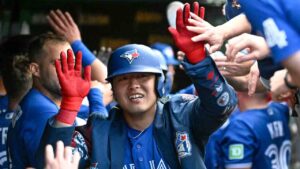
Plenty of players could step up as impactful contributors to the Toronto Blue Jays' wild-card push, but some stand to play more pivotal roles than others.
Toronto's improbable surge back into post-season contention over the last four weeks has already been driven by outsized production from both unexpected newcomers like Brett Bateman and foundational pieces like Dylan Cease and Alejandro Kirk.
They've helped the Blue Jays get hot — their 16-10 record since July 27 is tied for fourth-best in the majors. Still, a team four games below .500 with a steeply negative run differential is bound to have some precariously balanced areas on its roster, especially after taking a hybrid approach at the Aug. 3 trade deadline that saw them subtract some pieces. With that in mind, let's identify a few X-factors the Blue Jays will be particularly reliant on down the stretch.
Mad Max defying Father Time
There have been a few times this season when the Blue Jays have seen the mirage of a starting-pitching surplus.
First, during spring training, their rotation appeared to run eight deep before Shane Bieber and Trey Yesavage's seasons were delayed, and Cody Ponce and José Berríos lost theirs to injury. Then, after the deadline, Toronto tried to run a six-man rotation, but that plan was derailed by attrition within a week.
Now, Cease, Bieber and deadline-acquisition Jose Soriano are holding down their spots reliably, and another addition, Spencer Arrighetti, seems primed to take over what was previously a bullpen day. The most tenuous turn of the rotation appears to be 42-year-old Max Scherzer.
Before getting tagged for seven runs against the Tampa Bay Rays on Wednesday, Scherzer pitched to a 2.37 ERA with 17 strikeouts and six walks over his previous four starts. Even that start against the Rays could have potentially been scoreless if not for a couple of misadventures in left field by Jesús Sánchez.
Scherzer's performance hasn't been an issue lately. But he's made only 37 starts over the last three seasons due to myriad injuries and is nearing the end of his storied career, so continued health and consistency are far from guaranteed.
There aren't many examples of pitching successfully (or at all) past age 42 this century, this side of Roger Clemens. Scherzer's season won't go down as one after a disastrous April inflated his ERA. But his combination of hyper-competitiveness and talent has made him an outlier his entire career. With a bullpen that ranks second in innings pitched in August, the Blue Jays are counting on one more anomalous run from Scherzer to keep their pitching staff from coming apart at the seams.
The next chapter of the Rule 5 success story
The Blue Jays have asked a lot of Rule 5 draft selection Spencer Miles. First, it was eating innings as either a pseudo starter or bulk guy after pitching only 14.2 career innings in the minors. Now, it's stepping into the high-leverage role left behind when Jeff Hoffman was traded to the Minnesota Twins.
Miles has been successful and versatile, pitching to a 3.02 ERA that almost perfectly matches his 3.01 expected ERA while switching between starting, long relief and a traditional bullpen role. As a ground-ball pitcher with a four-pitch mix that induces soft contact and allows him to work efficiently (89th percentile average exit velocity and ground-ball rate), Miles has the profile of a starter.
But his sinker can also play up in short spurts, reaching a season-high 99.2 m.p.h. in an at-bat against Adley Rutschman on Aug. 11. That, along with a curveball that grades out as his best offering by Stuff+ and putaway percentage, has accounted for 78 per cent of his pitches since his most recent role change. The sinker has gained a tick of average velocity in this span (96.2 m.p.h. to 97.1 m.p.h.), and the curveball's spin rate has jumped at times. In his most recent outing against the Yankees, he threw those two offerings exclusively.
While those weapons raise his ceiling in one-inning bursts, Miles is far behind Hoffman in a key aspect for leverage arms: missing bats. Toronto's former closer is elite in this area and has a significant edge on the rookie right-hander in whiff rate, chase rate and strikeout rate this year.
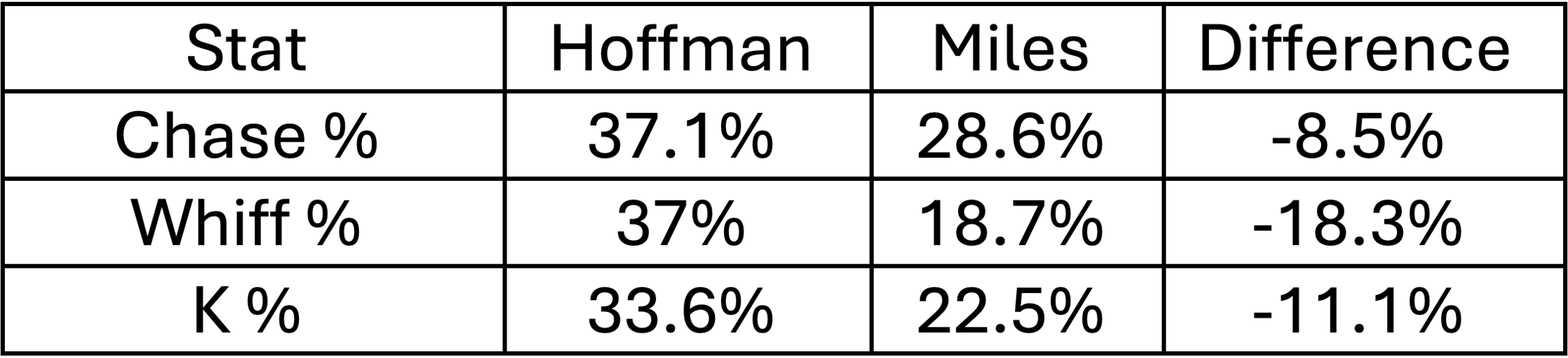
The Blue Jays' other leverage righty, Tyler Rogers, leans even further into soft-contact outs. Both pitchers' results have been better than Hoffman's this season, but the Blue Jays won't be able to rely on as many strikeouts to escape late-inning jams.
The face of the franchise
It's rare for a bottom-five team in every major offensive category to find itself in the thick of a playoff race.
So Kirk stepping up as a carrying force for the Blue Jays' offence in recent weeks has been extra meaningful. For a team that ranks 28th in home runs and last in isolated slugging, an injection of power could swing a few games when the margins are razor thin. But it was the Blue Jays' star first baseman, not its catcher, that was supposed to shoulder that load.
Instead, Vladimir Guerrero Jr. has had one of the more perplexing and unprecedented declines in MLB history. His 73 wRC+ since May 1 is a bottom-five mark in MLB, and he's one of only two qualified players yet to go yard at their home ballpark. The other, Chandler Simpson, hasn't hit a home run in his entire career.
It seems far-fetched given his recent performance, but Guerrero clicking, turning a corner and getting red-hot for the final month and change is still within the realm of possibility. He's done it before. We all remember Bo Bichette's red-hot September turnaround in 2022, and a similarly struggling Cal Raleigh just broke out with three home runs Monday night. These things happen.
Guerrero going on a heater for the final month of the season wouldn't undo the first five, but it would be less shocking than his performance so far.
 1:11
1:11