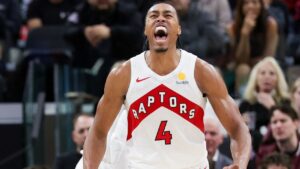
The first 16 games of the Toronto Raptors season haven't exactly gone according to plan.
Sure, it was expected that Kawhi Leonard — who's averaged just 53 games per season over his 15-year career — would miss time. But the all-NBA wing missing almost all of the Raptors' games so far is high on the list of worst possible outcomes. Scottie Barnes, RJ Barrett and Immanuel Quickley have also combined to miss nine games. The Raptors have often had to figure out a makeshift rotation on the fly.
These improvised Raptors have gone 4-10 without Leonard and 1-4 without him and Barnes, but there have still been bright spots. The injuries have provided ample opportunity for Toronto's young depth. Most recently, 20-year-old Allen Graves recorded the first 20-point, 10-rebound double-double by a Raptors rookie since Barnes in a rousing win over the Detroit Pistons.
The Raptors have had to fill over 50 extra minutes per game on average. Some bench players have seen their time on the floor increase, and others have been thrust into the rotation. There have also understandably been growing pains.
Let's check in on how Toronto's depth has handled the extra playing time.
Allen Graves
The rookie got his first NBA start on Friday, played a career-high 31 minutes and made the absolute most of it.
That's kind of been his entire modus operandi. Ever since Graves stepped on the floor at Summer League, he's hustled relentlessly. The 19th overall pick has a seemingly preternatural ability to get his hands on the ball. It's a good combination and bears out in the numbers.
He leads all rookies in loose balls recovered per 36 minutes and his block percentage is second only to seven-foot-three centre Aday Mara.
But where Graves really excels is the offensive glass. His 11.1 per cent offensive rebounding rate ranks second among non-centres, behind only Jordan Goodwin (according to Cleaning the Glass, which filters out garbage time). And that's counting the entire NBA, not just rookies. Graves' plus-11.3 per cent on/off impact on the Raptors' offensive rebounding also grades out in the 99th percentile. It's no surprise that over half of his two-point field goals have come on putbacks. Graves' 1.44 points per possession on second-chance points leads all rookies and is sixth league-wide, just behind Victor Wembanyama.
His vigorous play, instincts and seven-foot wingspan have also helped him adjust quickly to the Raptors' aggressive defensive scheme. And his three-point shot has started to drop, too (30.6 per cent on the season but 40 per cent over his last seven games). All these factors have come together and allowed Graves to quickly fit into the Raptors rotation in his first pro season.
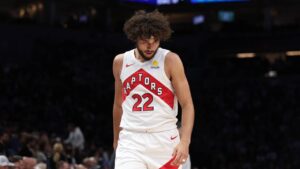
Walter established himself as a bona fide sharpshooter by hitting 47.6 per cent of his triples after the all-star break last season, good for second in the NBA (minimum 100 attempts).
His jump shot has been streaky to start the season — Walter was shooting 32.6 per cent from downtown until a 12-for-28 stretch over the last three games bumped it up to 35.1 — but that's the life of a shooter. Variance is the name of the game. He's a 37.8 per cent shooter over 570 career attempts, and based on his clean and repeatable mechanics, it stands to reason he'll normalize somewhere close to that number.
More notable is that the volume and difficulty of Walter's shot diet have increased. He should be taking more shots since he's stepped into the starting lineup for Leonard and his minutes have increased from 20.5 per game last season to 31.4 now. But his three-point attempts have still scaled up further, from an average of 3.7 to 7.1. He's taking fewer easy corner threes, more difficult ones from above the break and has doubled his frequency of shots off movement. Walter is developing from a standstill shooter to a more dynamic one and doing it from areas of the floor that are easier to access. That's meaningful for a Raptors team bereft of shooting (tied for 25th in the NBA at 11.9 threes per game).
Meanwhile, he's remained the stickiest point-of-attack defender on the Raptors roster. Walter was the subject of the annual media day muscle watch this season, and the apparent 10 pounds of additional mass — according to Darko Rajakovic — appears to have made him more difficult to shed when badgering ball handlers.
Walter has sharpened his existing toolkit, but adding new tools has been a mixed bag. He scored two self-created buckets in the Raptors' first game of the season, and he's been given additional second-side ball-handling duties by necessity. There have been flashes of promise, but also frequent blunders. His ability to put the ball on the floor and get to his own shot, or create for teammates, remains a work in progress.
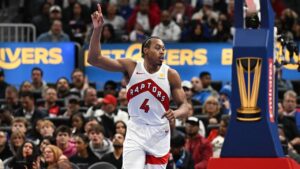
Shead has become the poster boy for low-usage, high-assist guards. He ranked in the 98th percentile in assist-to-usage ratio last season and is in the 100th percentile this season.
His decisive playmaking has been a boon for the Raptors' 27th-ranked half-court offence (91.6 points per 100 plays according to Cleaning the Glass), and his pick-and-roll combination with Jakob Poeltl has been particularly effective. Shead sets up the Austrian big close to the rim more often than Quickley. The backup point guard had 27 assists over back-to-back starts with Quickley out.
But a lack of consistency in scoring the basketball continues to limit Shead's ceiling. His field-goal percentage (36.7) ranked second-to-last in the NBA last season and his effective field goal percentage (45.1) and true shooting percentage (49.1) were both bottom-five. His eFG percentage and true shooting are both worse this season (43.8 and 48.7, respectively).
He's had a couple of enticing outbursts, including a 20-point game against the Grizzlies and 19 in an overtime loss to the Knicks, but those performances were fuelled by 7-for-16 three-point shooting that probably can't be relied on.
One thing you can count on from Shead: drawing a ton of moving screens. He finished second in offensive fouls drawn last season (66) and is tied for second again with 17.
Murray-Boyles hasn't quite taken the leap that this writer predicted. Nor has his elite rim-finishing from the Raptors' first-round playoff series against the Cavaliers been sustained. But he can still hang his hat on superlative defence.
The 21-year-old sophomore's already stellar steal and block rates have ticked up from last season, and his ability to switch from bigs to smalls (Karl-Anthony Towns to Jalen Brunson, for example) is only paralleled by his teammate, Barnes.
As mentioned with Graves, the Raptors are a team full of players with exceptional hands. Murray-Boyles leads them all with 5.4 deflections per 36 minutes, a top-10 mark in the league. And "The Klaw" isn't even back yet.
One area to watch is the frequency of Murray-Boyles' drives. He has been driving the ball slightly less often this season, despite that being a strength of his in college and a potential area for development.
Similar to Walter, Battle is one of the Raptors' few shooters, and his minutes per game have leapt by 10 season-over-season (from 8.5 to 18.8). The exception is that for an ostensible shooting specialist, Battle is remarkably consistent.
He first strong-armed his way onto the Raptors roster after shooting 17-for-29 during Summer League and the pre-season after signing undrafted in 2024. Battle is now shooting over 40 per cent from three for a third straight season.
The conventional wisdom among analytically minded NBA circles is that three-point percentage stabilizes at about 750 attempts. Battle isn't quite there yet, but he is shooting 41.1 per cent on 421 shots. Add that he shot 45.8 per cent on 107 G League triples over the last two seasons, and that sample is looking even healthier. Like Walter, Battle has also started to prove he's more than just a standstill shooter.
The Raptors Show
Sportsnet's Blake Murphy and two-time NBA champion Matt Bonner cover all things Raptors and the NBA. Airing every weekday live on Sportsnet 590 The FAN from 11 a.m.-noon ET.
Latest episode
Battle's defence gets a bad rap, but that is misguided in some respects. Opposing half-court offences were significantly worse when Battle was on the floor over the last two seasons. That doesn't mean he drives defensive success, but he can be a part of it. Battle gets blown by sometimes, but he also hangs in at times, too.
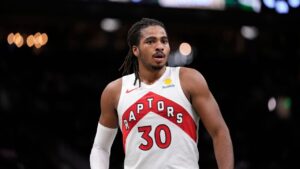
Martin lit the G League on fire last season, propelling Raptors 905 to a record 16-0 start en route to making an All-NBA G League third team.
When called upon amidst the injury fray, he's stepped up. Martin's shooting an absurd 48.1 per cent from three, has a 71.7 per cent true shooting percentage and played hero with 27 points in an NBA Cup win over the Milwaukee Bucks. Of course, it's over a tiny 188-minute sample, and those numbers aren't sustainable, but he's certainly made the most of his chance.
The 24-year-old still gets lost in the Raptors' help-heavy scheme sometimes, but his bullish on-ball defence fits Toronto's "point-of-attack defender is the most important guy" ethos.
Martin is on the periphery of the Raptors' rotation and is the most likely to leave it when players return, but he also has a fierce competitive edge, making him a hard guy to count out.