The easy part is over with.
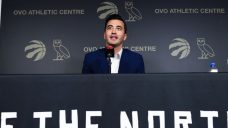
It’s expected the Toronto Raptors will announce a multi-year contract extension for head coach Darko Rajakovic early this week, both as a reward for a job well done and a bet that he can continue to develop as a longtime leader of a team that’s trying to transition from "pretty good" to "actually good" and, ideally, much better than that over the life of the deal.
It cleans up the fun part of the Raptors' off-season, which included a new contract for executive vice president and general manager Bobby Webster that kicks in for 2026-27 and runs five years, coinciding with what figures to be the prime of Scottie Barnes’ career.
Certainly, Rajakovic deserves plenty of credit for a feel-good season where the Raptors not only jumped from 30 to 46 wins but from 11th place in the Eastern Conference to fifth. The improvement in large part came because the Raptors crafted an identity under Rajakovic as a hard-playing, ball-hawking group that emerged as the NBA’s fifth-rated defence, even while centre Jakob Poeltl played just 46 games and was hampered in many more with a back problem.
And Rajakovic earned good grades in the Raptors’ seven-game, first-round loss to the heavily-favoured Cleveland Cavaliers, making some nimble mid-stream decisions on personnel and providing a game plan that gave Cleveland guards Donovan Mitchell and James Harden fits while giving the Raptors — down starters Immanuel Quickley and Brandon Ingram — a chance at an upset.
But the low-hanging fruit has been plucked.
With Webster, and now Rajakovic, very much part of the Raptors’ future, the question as the pace of the NBA’s off-season gathers momentum — with the draft on Tuesday and Wednesday night and all the related league-wide roster shuffling that comes along with it — is how do the Raptors move out of the league’s mushy middle and more firmly into the contending class?
Past performance is no guarantee of future success, particularly in an Eastern Conference that promises to be deeper and more competitive than last season, with the Indiana Pacers back to health, the Washington Wizards pivoting from tanking and the increasing possibility that Milwaukee Bucks star Giannis Antetokounmpo will be traded, with the Miami Heat and Boston Celtics reported as the most likely destinations. Internal improvement will have to be a part of it, but an injection of talent or some roster rebalancing would help advance the project.
In some ways, Rajakovic’s ability to keep the Raptors fully bought in to his message and continue to coax improvement from various corners of his roster is more vital than ever, given the means Webster has to make significant changes are somewhat limited. The salary owed to the five projected starters takes up 98.9 per cent of the salary cap and the current payroll leaves Toronto with roughly $6.7 million under the luxury tax threshold.
But that doesn’t mean the team will look the same at training camp in October as it does now.
Following news of Webster’s contract extension earlier this month, he spoke about how his team might approach its next steps.
“I think we were the youngest team in the playoffs, and so there is that internal growth (we are expecting), and then you're obviously gonna look at opportunities to not necessarily speed it up but maybe start to push some chips into the middle,” said Webster. “And I think that's probably what we're sort of thinking about.
“(You look at the Finals) and you have two teams that were constructed very differently. The Knicks were constructed primarily through trades and free agency, and you have San Antonio, who's constructed from the draft. There are different types of championship level teams, and so we're studying it.”
The most likely development as the off-season unfolds will be a new address for Gradey Dick, the fourth-year wing who was leapfrogged in the rotation by Ja'Kobe Walter, Jamison Battle and A.J. Lawson in the final weeks of the season. Per sources, it’s a move that Dick would be open to as he looks for a fresh start and a chance to pick up from his promising second season (14.4 points per game with 54 starts) after things went south in Year 3 (six points per game with one start).
The sense is there will be interested suitors among rebuilding teams to see if they can unlock the 22-year-old former lottery pick’s promise, with the one year and $7.1 million left on his rookie deal either being added to broaden a bigger deal, or potentially being traded into cap space with the Chicago Bulls (with $55 million of space) and Brooklyn Nets ($33 million) as possible destinations for the price of a second-round pick, for example.
A stand-alone deal sending Dick into another team’s cap space would have the added benefit for the Raptors of giving them more wiggle room as they try to retain Sandro Mamukelashvili, who had a breakout season (11.2 points and 4.9 rebounds while shooting 38.9 per cent from three on nearly four attempts per game) in his first chance at meaningful NBA minutes. He has a player option on the second year of his contract that is on the books for $2.8 million that he will almost certainly decline, making himself a free agent.
The amicable 27-year-old will likely be able to command a contract larger than a deal the Raptors can currently offer without running the risk of tipping over the luxury-tax threshold. If Dick ends up being traded into another team’s cap space, however, the Raptors would be able to offer a deal that would start at about $10 million. That might be enough to keep him, but it’s no sure thing in a market where floor-spreading bigs are always in high demand.
The single most useful trade chip the Raptors have is the expiring contract belonging to small forward RJ Barrett, the 26-year-old from Mississauga, Ont., who is coming off his best all-around season (19.3 points, 5.3 rebounds, 3.3 assists on a career-high 58.5 true shooting) and a strong playoff (24.1/7.0/4.0/56.3) and is owed $29.6 million next season. Barrett has been a good performer in Toronto and a solid locker-room leader, but given he’s eligible for a four-year contract extension worth as much as $185.6 million, he may be a casualty of the Raptors’ roster crunch.
The challenge for the Raptors coming off their first playoff appearance since 2021-22 is that they don’t realistically have the luxury of idling or taking a step backwards to move forward. As young as their bench is, their starters are not. Barnes is entering his sixth season and starting the prime of his career. Barrett is heading into Year 8, for Quickley it will be Year 7 and Ingram and Poeltl are both set to begin Year 11.
So any moves to come have to be made with an eye toward making the team better in the near term. Completing a trade is one thing, improving a 46-win team while staying under the luxury tax is another.
The Raptors have other big contracts that can be used in a deal — Quickley’s (four years and $130 million) and Poeltl’s (four years, $103.5 million, although only $81.3 million of that is guaranteed) — but the appetite for taking on long-term financial commitments for players that are unlikely to significantly out-perform their value in the NBA’s more restrictive salary-cap environment is as low as it has ever been.
While Quickley’s deal might be a bit longer and richer than ideal, he remains a solid NBA point guard who can play well off the ball, making him a good fit around the likes of Barnes and Ingram. Poeltl’s deal, on the other hand, is what represents the problem, especially given his age (30), and a relatively under-performing season capped by a similar showing in the playoffs.
A couple of league sources have suggested that the Raptors could be interested in Bucks centre Myles Turner if the Bucks go into fire-sale mode after a potential Antetokounmpo trade.
Mileage may vary on whether the 30-year-old Turner, coming off a down year and with three years and $83.8 million remaining on his deal, is an upgrade on Poeltl, but his profile as a floor-stretching rim protector (he’s averaged 1.9 blocks and 1.8 threes per game on 38.3 per cent shooting from deep over the past four seasons) might fit the Raptors’ needs better than the non-shooting Poeltl, whom the Cavaliers refused to guard outside 10 feet during the playoffs and created spacing issues for the likes of Barnes and Ingram.
A deal built around Poeltl and Dick would work financially. The rebuilding Bucks would doubtlessly be looking for first-round picks as compensation for taking on an extra year of Poeltl’s contract. How many would be the question.
Similarly, league sources have connected the Raptors to Sacramento Kings big man Domantas Sabonis — similar rumours were prevalent at the trade deadline — but, in previous reporting, the sense was most of the discussion around that was being driven by Sabonis’s camp, working to get the 30-year-old three-time all-star out of the rebuilding situation with the Kings.
Objectively, Sabonis’s rebounding, passing and finishing would be a nice fit with the Raptors’ offence (prior to an injury-plagued 2025-26 season, the typically durable veteran averaged 19.2 points, 13.3 rebounds and 7.2 assists on 62.5 per cent shooting with the Kings), but his defence and rim protection would present a challenge, as would absorbing the $45.5 million and $48.6 million he has remaining on the last two years of his contract.
A Poeltl and Barrett deal for Sabonis works financially, and the Kings are often connected to the Raptors since general manager Scott Perry drafted Barrett third overall when he was running the New York Knicks.
We’ll see.
As always, the most likely scenario is that there are less moves than more, and that the Raptors’ most significant transactions will be moving on from Dick as part of an effort to retain Mamukelashvilli. But as the NBA’s transaction cycle heads into overdrive in the coming 10 days, there’s always the possibility a team like the Raptors is able to find a pathway to a bigger deal.



 1:51
1:51