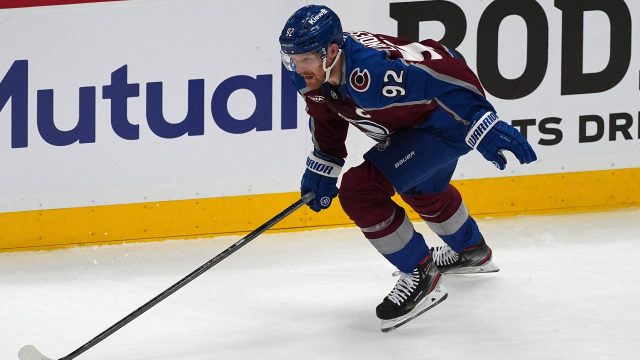
DENVER — Gabriel Landeskog wears the small sensors in the insoles of his skates for practices and games. He wears them in his sneakers when he's training and, maybe most handy of all, while taking his dog for a walk.
Those spins around the block and ice record all of his biomechanical measurements. The numbers provided a blueprint in helping the Colorado Avalanche captain resume his career after a three-year gap caused by a complicated knee injury. Now, they keep him at his gritty, goal-scoring best.
The collected data ranges from movement patterns to his asymmetry and whether he’s favouring his surgically repaired right knee. It calculates in-game/in-practice workloads, stride characteristics and the mechanics of how his feet interact with various surfaces — ground or ice.
Basically, the details paint a picture to inform Landeskog when he's reaching maximum capacity and needs a break. That way, it prevents him from reaching overexertion levels in training that might set him back for days, possibly even weeks.
“This detects any red flags before I even feel them,” said Landeskog, whose team trails Vegas 3-0 in a Western Conference Final in which he has two of the Avalanche's six goals. “It’s been super important for me, and a huge help.”
The assist goes to Plantiga, an AI-driven movement platform that helps athletes stay on top of their game and prevent injuries. The company's cutting-edge technology is being utilized by players and teams in the NBA, NFL, WNBA and MLB, along with colleges, elite sprinters, weekend warriors and, of course, NHL players such as Landeskog.
"What we’re trying to detect is the smoke before the fire,” explained Matthew Jordan, a scientific adviser to Plantiga as well as an associate professor, faculty of kinesiology/sport medicine centre, at the University of Calgary. “Imagine you’re at the point where your knee is just at the cusp of, 'My knee’s killing me. I can hardly walk.’ We can see this in the data before you reach that tipping point.”
Landeskog's return from knee injury
Landeskog’s knee issues began after a skate blade cut his right knee during the 2020 playoffs in the Edmonton bubble. He worked his way through it and helped the Avalanche to a Stanley Cup title in 2022 by beating Tampa Bay.
That Cup clincher, though, was his last game for a while. After missing a full season, Landeskog underwent cartilage replacement surgery on May 10, 2023.
Introduction to Plantiga
In the spring of 2024, Landeskog was introduced to Plantiga, the Vancouver-based human analytics company founded by Quin Sandler and his late father, Norman McKay. They wanted to create a way to monitor the movement of athletes with wearable in-shoe technology.
Landeskog reached out to the Plantiga team through strength and conditioning coach Marcin Goszczynski. The 33-year-old Landeskog met with Jordan at a game when the Avalanche were playing in Calgary.
“We discussed his injury and his frustration with the process,” Jordan recounted. “You have to remember at this point the tunnel was dark and long — there was no light ... we were miles from the end of the tunnel.”
Jordan connected Landeskog with a Canadian ski racer who went through a similar injury.
“It was a relief for Gabe to know that another athlete out there had been able to conquer this injury," Jordan said. "Has among the best mindsets, and he is 100 per cent resilient and gritty to the core.”
By utilizing “Norman,” the movement intelligence layer named after Sandler's father, potential changes in Landeskog's biomechanics were flagged before they could escalate.
“We’re trying to put really good data (together) that him and his trainer will use,” Sandler said. “There’s this fine Goldilocks zone that we help him stay in, and honestly he’s been killing it.”
Staying on top of the data
Landeskog returned last season for Game 3 of the playoffs against Dallas, which was his first NHL contest in some 1,032 days. His comeback continued this season, when he had 14 goals and 21 assists over 60 regular-season games.
Throughout the season, Jordan tunes in to watch Landeskog’s strides on the ice. He sometimes notes instances he wants to examine further simply because the numbers may be outside the Swedish forward's normal range.
“Essentially, put out the ‘smoke’ before it turns into a ‘fire,’” Jordan explained. “In an athlete’s world, a fire can mean a new injury, a reinjury to the tissue, a loss of performance or a setback in rehab.”
This application is similar to the Oura Ring, which constantly collects health and wellness metrics. Plantiga, though, tracks human movement through a laboratory-grade inertial measurement unit (IMU) sensor that captures 400 data points per second.
Watch the Stanley Cup Playoffs on Sportsnet
The quest for the Stanley Cup begins with 16 teams and ends with one champion. Don't miss a moment of the Stanley Cup Playoffs with every game on Sportsnet and Sportsnet+.
Broadcast schedule
Translation: An athlete’s movement can be captured with 20-to-30 times more granularity than a smart phone or watch.
“A supercharged human movement measuring device,” Jordan said.
One way to get a baseline for Landeskog’s gait and biomechanics was through walking. For that, an assist goes to his dogs, the late Zoey and now Mila, who were eager participants on those data-collecting excursions.
“We can see subtle things in your walk patterns well before it manifests as something very clinical or significant,” Jordan said.
Taking out the guesswork
What the data did for Landeskog was take the guesswork out of his training program.
“He’d get on the ice and be like, ‘Oh, I feel good today.' Jordan said. “It’s like, ‘I think I’m just going to go hard. I feel like my knee feels really good. Oh (no), I went too far. My knee’s flared up. I've got to take a week off.’ With all these setbacks he couldn’t catch any progression.”
Now, when the numbers indicate he should rest, he pays attention. He's a finalist for the Bill Masterton Memorial Trophy, which is awarded to the NHL player who exemplifies perseverance, sportsmanship and dedication.
“I’m humbled and honored by it, but I think for me, the ultimate prize I’ve already won," Landeskog said. “That’s to continue working and getting to play hockey.”
 1:25
1:25