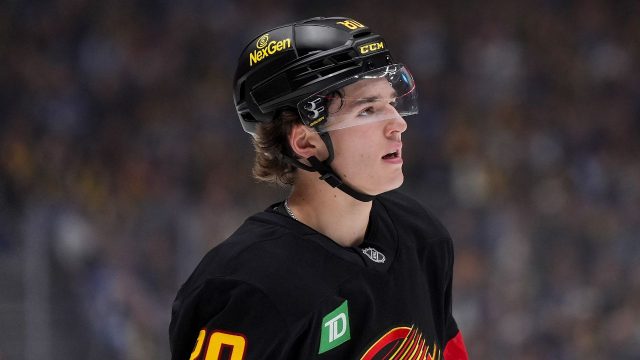
ABBOTSFORD, B.C. — When Braeden Cootes deftly sifted through Caleb Malhotra’s forecheck to start a solo rush that ended with a spectacular three-on-three goal Thursday at the Vancouver Canucks’ development camp, it wasn’t the first time the team’s two best prospects came together.
Centres who are vital to the rebuilding Canucks’ future, Cootes and Malhotra were roommates for the three-day orientation camp.
“I never played against him before, but getting to know him these last three or four days has been awesome,” Cootes said. “He's played with a couple of guys that I played with before, and I've heard nothing but great things (about him). He's a great kid and an unreal player with a really bright future. So I'm really excited that we picked him.”
And as a roommate?
“Low maintenance,” Cootes said.
The camp at Rogers Forum, home of Vancouver’s minor-league team, opened just four days after the Canucks selected Malhotra third overall on Friday with the franchise’s highest draft pick in 27 years.
As an elite prospect, the player the Canucks drafted 15th last year, Cootes was like the organization’s favoured first-born child — right up until his baby brother joined the family on Friday.
Suddenly, Cootes, the 19-year-old from Edmonton, is not the Canucks’ shiniest prospect.
But he is still the one most likely to be on the team’s roster next fall after appearing in three NHL games last October when he was the first 18-year-old to make the Canucks out of training camp since Petr Nedved in 1990.
Malhotra, 18, is likely headed to Boston University while Cootes tries to stick with the Canucks after an excellent draft-plus-one season in junior hockey.
“I mean, it's good that we're getting more players,” Cootes said of yielding some of the spotlight to Malhotra. “That's what you want. We want to build a good team. I don't want it just to be me, right? Like, I want more really good players, and that's how you build a championship team. So it's awesome that we're getting high draft picks. Hopefully, in the future, we don't need high draft picks, and they're all on the team. It’s just exciting that we get these really good players.”
At minimum, Cootes looks like he too will be a “really good player” for the Canucks. And he could be more — even if he eventually plays behind Malhotra at centre in Vancouver.
Using his impressive NHL training camp as a launch pad, Cootes made Canada’s team for the world junior championships this past season, amassed 63 points in 45 junior games for Seattle and Prince Albert — he was traded mid-season by the rebuilding Thunderbirds — and helped drive the Raiders to the Western Hockey League final.
Cootes was noticeably bigger, stronger and faster at development camp than he was last summer, but feels his biggest improvement has been mentally.
“I’m probably five or seven pounds more, like 191 or 192,” the six-foot centre explained. “In (Prince Albert), I had awesome billets and they fed me like a king. I was pretty spoiled. I actually gained a little bit of weight — good weight — being there, and I've been trying to do that.
“I think the biggest thing is just confidence, honestly. I know I wasn't fully ready (for the NHL last fall), but it gave me a sense of, like, ‘I want to get back there as soon as possible.’ I knew I can do it, and I can be a good player in that league, just maybe not then. When I went back to Seattle ... it kind of lit a little fire under me just to, you know, work as hard as I could so I could get back there.”
But while Cootes was working and building his speedy two-way game, the Canucks were collapsing.
Remember, when Cootes made the NHL team’s opening-night lineup nine months ago, the Canucks were an experienced team led by a superstar defenceman, and were plotting a return to the Stanley Cup Playoffs. But Quinn Hughes was traded in December, followed soon by other veterans, and the Canucks turned dramatically into a rebuild as they plummeted to last place in the league.
Not only is Cootes a better player now, but the landscape for him — or any young player — to make the Canucks this fall is more inviting.
“It was kind of an interesting situation,” he understated when asked about watching the Canucks from afar. “But also it was tough to see, like, Quinn, (Conor) Garland and (Tyler) Myers go because they're such awesome players and good people. But that’s just kind of how hockey goes sometimes; it doesn't always go your way. So, I mean, when I saw what was happening ... I was kind of excited for the opportunity. We're kind of going in this direction with a younger group. Especially for myself and where I'm at in my career, that’s exciting. I mean, it's tough to see the team take kind of a step back, but there's a lot of things in the future to look forward to.
“I feel a lot more ready. I mean, mentally, just from those three games (in the NHL) and from my season last year, I think there’s a lot. A little faster, a little stronger, but I would say just more mentally ready.”
Most of the Canucks’ top prospects showed well at development camp. The three most impressive players in Thursday’s three-on-three tournament were Cootes, Malhotra and 18-year-old Adam Novotny, the big, fast Czech winger the Canucks selected 24th on Friday from the Peterborough Petes. Malhotra played against Novotny in the Ontario Hockey League with the Brantford Bulldogs.
If Cootes is ready for the NHL in the fall, the Canucks will certainly be ready for him.
“I see he’s starting to become ready for something else (other) than juniors,” Canucks development coach Mikael Samuelsson said Thursday. “That's what I see, and a lot of things come to mind when I say that. I see a guy who's, like, on a mission. He wants to be the difference-maker, he wants to be the guy. But when we're sitting down, just being around the guys, (he is) the kind of guy we want on the team. What a great human being. We have his eyes when we're talking; he's listening. He’s listening to the experienced guys, too, whoever talks. He’s humble and treats people the right way.”
Under new management, headed by general manager Ryan Johnson, the Canucks are putting a premium on character and leadership as ingredients for building a healthier culture within the team. Cootes was Seattle’s captain.
Samuelsson said Cootes’ leadership qualities are obvious.
“I say it like this: First, you're quiet,” Samuelsson explained of the adjustment to professional hockey. “You're actually learning, but you’re still quiet. And then you can start to talk (and be a leader). He's in the learning process now. You can see he's taking a lot of things in. It's like he's getting ready for something else — to be a great teammate and a heckuva player, I think.”