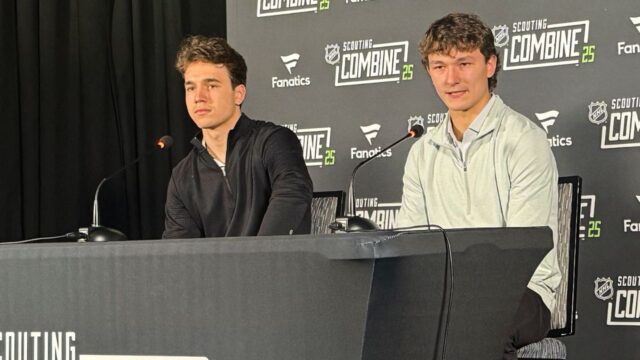
From the cynic’s perspective — which is perhaps a chair I’ve been too willing to inhabit in the past — the NHL Scouting Combine can look like a pointless, or even a bit of a weird exercise.
When Sam Bennett does zero pull-ups at the thing then goes on to win the Conn Smythe Trophy as the league's premiere scoring brute, are teams really learning much there?
But after spending some time around the event this week, it’s clear that what’s going on is about far more than just teenagers working out. Truth is, the working out part is mostly about establishing baselines and outliers. You’re just looking for those who are the freakishly strong (which is good), and who are freakishly weak (also good, as there’s room for vast improvement).
It’s actually tough to have a terrible physical showing, now that I think about it.
But there are real gains to be made beyond the bench press. It’s about the human element, getting to know people, and searching for those intangibles that aren’t gonna show up on a force plate.
What you’re seeing happen around sports these days is borderline tragic. The players have been professionalized since they were about six, from travel teams to skill sessions to summer skating and much more. By the time they show real aptitude and separate from the pack, they’ve got agents and media training and they’re just optimized at all times.
Kids pick up an ecosystem of people around them, and because most of those people are well-intentioned, they often form safety nets to protect them from failure, and even challenges. Dips in performance call the whole program into question, where the concept of learning through hard times is approved in concept but not in practice. Kids who struggle today may just go play somewhere else, rather than work through it.
From there, the kids are reduced to numbers, including the part that happens at the scouting combine.
What were your stats in this league, how does that compare to historical NHLers, how does that project going forward? How big are you, what’s your wingspan, do you drive possession with a smile on your face while picking up your teammates and showing leadership and taking care of your most-hard-done-by family member?
But the truth is, the value of the NHL’s draft combine is in the humanity of it. There’s something almost quaint about the whole thing.
The combine is a place where some of the top prospects go and shake hands with people and get to know them. The structured portion of it includes the NHL teams taking up an office in the arena suites, and the kids being booked into those suites for interviews (depending on which teams want to meet them). From there, they eventually join Sportsnet for 20 minutes or so as well, where a crew of people get the chance to pick their brains.
That’s led by Jason Bukala and Sam Cosentino, and I was there alongside Ailish Forfar and Colby Armstrong to lend an assist where I could. Most of that time will never be seen by anyone, but it’s used to try to figure out what makes these kids tick, and so we can better tell their story at the draft as a network. We met kids who spoke five languages, kids who’ve caught 30-pound fish, and kids with a passion for … saying the things their agents told them to say.
Oh, you also model your game after Patrice Bergeron, do you?
They’re by-and-large great, impressive kids just doing their best.
Beyond those chats, there’s something old-fashioned about the rest of the event. They’re seeing people in the hallways and restaurants and hotels. They’re off their tech, they’re shaking hands and chatting and laughing. They’re nervous but trying and growing more comfortable as the week goes on.
They’re meeting GMs and scouts and agents, sure, but they’re also meeting one another (often for the first time), and they’re finally getting to know the world they’re going to inhabit in the years ahead.
We can talk about “media training” all we like, but these are still 18-year-old kids. If you sit down with them in a room for 20 minutes and ask questions, you’re going to get a sense for who they are, how they carry themselves, how they see themselves and more.
If you’re an organization with a draft pick, I’ve gotta believe these meeting should have an outsized impact on how you draft, for one major reason: Past the first 10 picks, and then past the first round and into the early second, the rate of guys who actually play in the NHL drops precipitously.
Below is a graph from Dom Luszczyszyn of The Athletic, in an article of the value of a draft pick, based on wins contributed over a whole career. It’s basically freefall until the second round, where it levels out considerably.

So, if all the kids past the first round are in a cluster of “maybe?” and it’s unpredictable, shouldn’t you value the type of kids you admire, who you want your team to include if they do hit? Or who at least contribute positively to the org’s culture while they try?
All things being equal, getting a sense for who these people are should be defining for organizations. You should want to align yourself with those you like. Can you get fooled, of course, but that just gives the advantage to teams who are more human, who have some idea how to connect with people. And shouldn’t we all root for that to matter in sports today?
For us as a network, the results come on draft day, when we fill fans in on the type of players their team just drafted. For teams, decisions are made from impressions formed in these settings. And for the kids, they finally get to know the people who are going to be a big part of their lives in the years ahead.
So for all the things pro hockey has become, and how strange the concept of the combine may seem, it’s one of the year’s better events. The results don’t come to the fans today, but they do come.
Draft orders are now roughly built for each team, and they’ll be reshuffled after this week of social time with a big number of the kids getting the chance to stop by and say hello. The data from the testing is measurable, but the stuff from the interviews isn’t. And, thank god, because sports needs a respite from numbers, and there’s comfort in knowing you can’t entirely strip the humanity from the game, hard as we’ve been trying.


 5:15
5:15