
The year was 2011. The country was Israel, the court just on the outskirts of Tel Aviv.
Canada was taking on Israel in a key Davis Cup clash, and Milos Raonic, then 21, was returning to action after a three-month absence following a tumble on the fabled lawns of Wimbledon. The hip injury required surgery, but now Raonic was back and ready to resume his climb up the ATP Tour ladder.
The opponent was Amir Weintraub, who had won the Israeli tennis title two years earlier, but otherwise was an undistinguished tour pro. A perfect opponent for Raonic on the comeback trail, except it didn’t quite work out that way.
Raonic won the first set and looked OK, but after that, it was a nightmare in front of a loudly partisan crowd. He lost the next three sets to the 182nd-ranked Weintraub and the rubber. He performed so badly he then pulled out of his next match. It put Canada in a big hole, and the heroics of Vasek Pospisil were required to subdue the Israelis and get Canada back into the World Group of the Davis Cup.
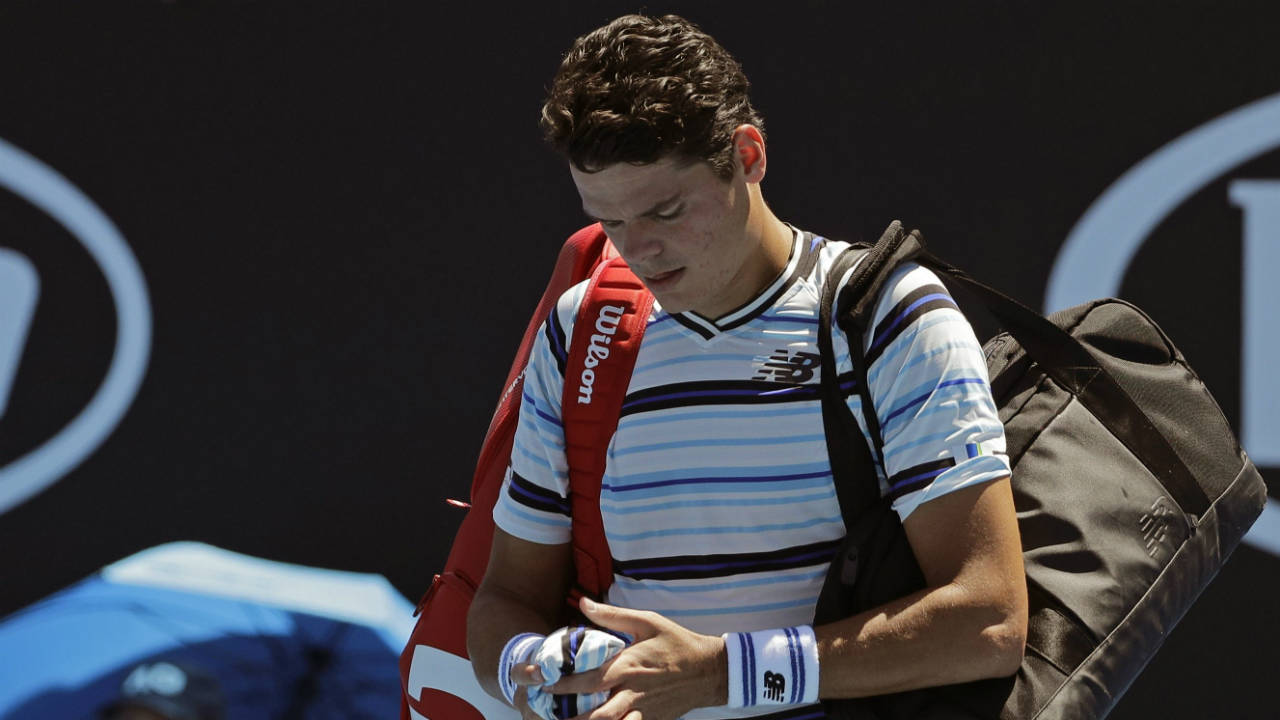
This week, on the second day of the 2018 Australian Open, it was like history was repeating itself. This time, it was Raonic’s second match since departing the ATP tour with a variety of injuries three months earlier. He’d lost his return match last week to an upstart teenager in Brisbane to start the ’18 season, but surely against 30-year-old Lukas Lacko of Slovakia, a tennis journeyman with limited weapons, Raonic would start in Melbourne to again look like the player who was fifth in the world last year.
Instead, it turned into a replay of the Weintraub nightmare. Raonic jumped ahead 3-0 in the first set then stalled. He managed to win the set, but Lacko, despite a career record well below .500, suddenly had belief against the big man from Canada, and started to dig into the match.
That’s the nature of the deep ATP Tour, of course. Even players outside the top 100 can play, and at No. 86 in the world, Lacko started to show that he had some ideas and shots he could make. Gradually, Raonic started to labour and struggle.
His serve, for the most part, was working, and he aced Lacko repeatedly. But no other part of his game was functioning consistently or reliably, and his movement, always a vulnerability, was a complete nightmare. Lacko shots that weren’t even down the lines turned into winners. Raonic didn’t even bother running after some of them.
“I’m not where I need to be at,” said Raonic afterwards. “I struggled physically, but thankfully not through injury. Just in terms of fitness and being prepared. I was just not sharp, not quick, not hitting hard or aggressive, and I couldn’t dictate.”
[relatedlinks]
For Raonic, coming back off a layoff isn’t the same as Novak Djokovic or Stan Wawrinka, both of whom got through the first round Down Under after significant layoffs. Pure athleticism isn’t what got Raonic near the top of the tour. He mastered the most important stroke in the sport, the serve, then built a game around it, working hard to improve each part of his game over the years until there were no major shortcomings.
Raonic is more like Argentine veteran Juan Martin del Potro, another big man who takes a while to get rolling again after injuries. Raonic has a lot of battle scars, has spent a lot of hours in rehab, and is now again fighting back from a long injury layoff.
The question probably isn’t whether he’ll be able to compete with the game’s elite again. His serve, still monstrous, almost guarantees that, and he had 80 winners against Lacko. It’s more a question of how long it will take, and based on the Lacko loss, this might take a while, probably well into the clay court season.
Raonic used to lead Canada’s Davis Cup squad, but last year handed that role to 18-year-old Denis Shapovalov. Canada takes on Croatia on the road early next month, and it will be interesting to see if Raonic decides to participate.
“I was not prepared for this situation so I will take a whole new review,” said the always analytical Raonic.
As far as the tour goes, after losing to a player he should never lose to in his first opening-round loss at a major in seven years, Raonic is headed outside the top 30. Eugenie Bouchard, who along with Raonic was a standard-bearer for Canadian tennis until tumbling down the rankings herself, did manage to survive her first-round match against Oceane Dodin of France, a significant step forward.
Once, it would have been unthinkable to suggest Bouchard was the underdog against the 85th-ranked player in the world. But the 23-year-old Canadian has fallen outside of the top 100 players on the women’s tour, so facing Dodin was an opportunity for, at least to some degree, an upset.
Bouchard is now coached by American Harold Solomon, but if you’d hoped Solomon could convince her to take a different approach in matches, you’d be disappointed. As has been the case with all the different coaches she’s brought in since her strong season of 2014, Bouchard continues to hug the baseline and play an over-aggressive game she doesn’t play consistently or particularly well.
It was enough against the wildly erratic Dodin – two of her serves bounced at her own service line before hitting the net – in a 6-3, 7-6 (5) win for Bouchard, her first WTA win since August. Her reward? A match with world No. 1 Simona Halep. Beating Halep would be a massive upset for Bouchard at this point, although Halep has a chronic ankle problem and has yet to play her very best tennis at any of the four Grand Slam events.
Bouchard hasn’t played the 26-year-old Halep since 2014, and Halep beat her on two of three occasions that year. Just like Raonic, Bouchard is trying to get back to where she was, and her path to that objective is likely to take much longer than his.