As the season nears its end, Dylan Cease’s heater is losing steam.
The Toronto Blue Jays ace has just seen his four-seam fastball average less than 95 m.p.h. in consecutive starts for the first time in his MLB career, part of a velocity dip that has been happening for much of the year.
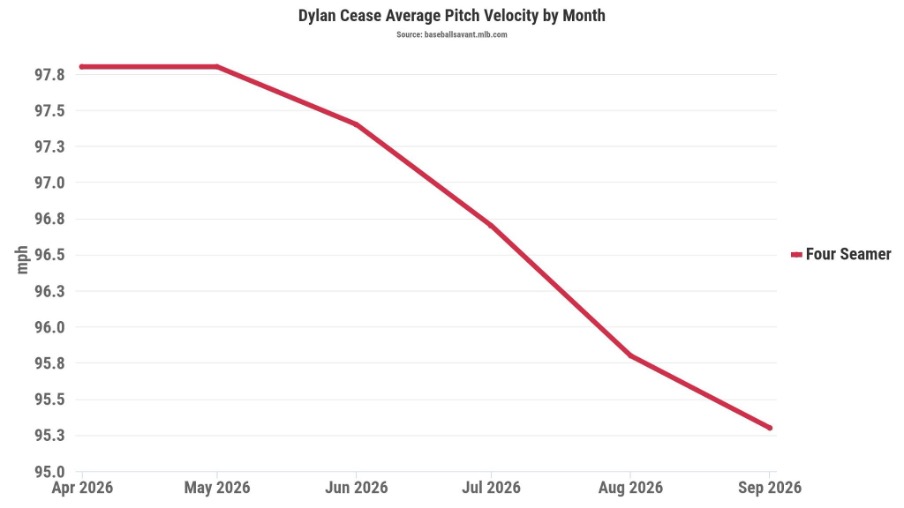
This chart tells an ominous story. Seeing it without any more context, you might assume it was describing the season of a pitcher who started out hot and fell off a cliff. While Cease has been shaky in his last two outings, that’s not a fair way to characterize his season, since some of his greatest success with run suppression has come later.
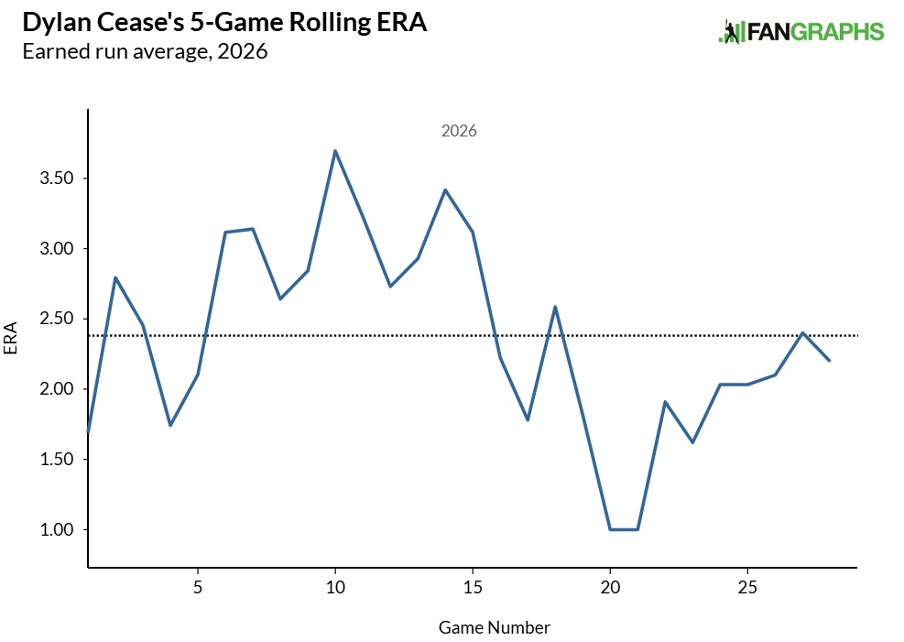
Clearly, Cease can still thrive with slightly diminished velocity, and he’s expressed confidence that his recent inability to light up the radar gun is not cause for concern. Even so, his last few outings could indicate there is a velocity loss threshold where he becomes significantly easier to hit.
Because the veteran right-hander’s velo has varied significantly over the course of his eight-year MLB career, there is plenty of data on how he’s fared when wielding fastballs of different speeds. For everything that follows, we’ll focus on his four-seamer, because he’s thrown less than half as many sinkers in his career (347) as four-seamers just this season (1,036). It’s a more impactful offering to his performance, and his average sinker velocity in a given start could be based on very few pitches.
The first way to examine how Cease fares when his velocity is down is to look at his success in starts when his average four-seam velo sits in different ranges. As the chart below shows, the sub-95 m.p.h. range is almost uncharted territory for him, although the numbers aren’t flattering.

These numbers are pretty clear-cut. Cease’s average velocity doesn’t seem to affect his control, but outside of the BB/9, he’s generally far more effective when it’s sitting in the high-90s. Many of the excellent numbers from the third row come from this season as Cease’s average velocity has been 97 m.p.h. or higher in 17 of his 28 starts, though it’s an average he hasn’t managed since July 8.
His starts above and below a 97-m.p.h. average line up nicely with the all-star break, and his results before and after are awfully similar.

His strikeouts have come down, and his limited history living below 95 m.p.h. is not encouraging, but through much of the summer he’s had no difficulty thriving in the 95-96.9 m.p.h. range, despite the fact that his career numbers in that area are middling.
It’s possible that his efforts to diversify his repertoire as a Blue Jay — and the emergence of his changeup as a deadly swing-and-miss offering — have helped him navigate the velocity dip. If you have a nasty slider and change, getting by with mid-90s heat should be enough, and what recent months have demonstrated is that the success of those other pitches wasn’t reliant on Cease consistently drilling in 98-m.p.h. heat.
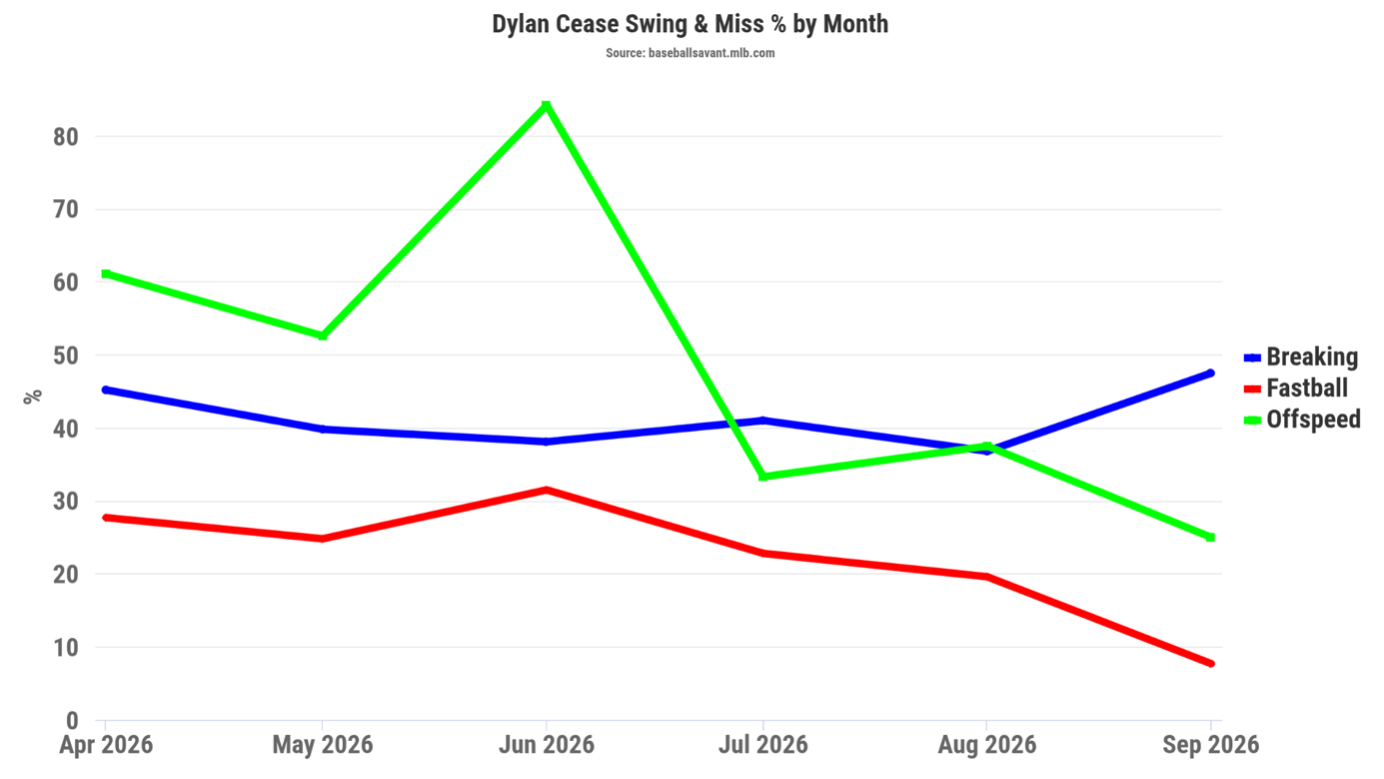
The dip on the fastball is noticeable, though. If we look at how his heater fares on a per-pitch basis at different speeds in his career, it’s clear that the whiffs are heavily tied to elite velo.
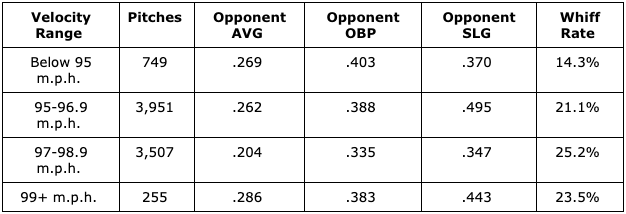
The fastballs at 99-and-up getting hit relatively hard is probably just a small-sample-size anomaly, though it’s possible their location is off. The two middle rows make for the most interesting comparison considering they come from such a strong sample, but, interestingly, Cease’s four-seamers below 95 haven’t exactly been hammered, even if the whiff rate is low.
Moving from career numbers to his 2026 production, Cease’s four-seamer success has been far less reliant on velocity.
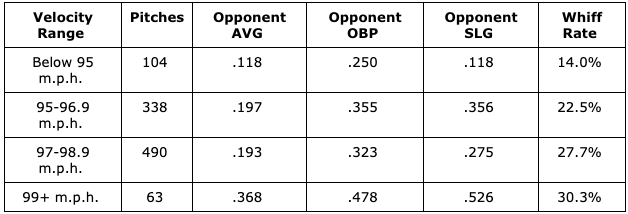
This muddies the situation slightly, although once again the theme of sub-95 four-seamers missing very few bats is consistent. The two middle rows also show that Cease tends to be at his best in the 97-98.9 range in larger samples.
Intuitively, we expect a starting pitcher to fare best when he throws his hardest, and most of the evidence suggests that’s broadly true for Cease. The stuff he’s shown in his last two outings has to be legitimately concerning for the Blue Jays, who desperately need him to give them a couple more stellar starts — even if Cease himself isn’t sounding any alarms. There isn’t much proof of concept for the veteran succeeding with the fastball he appears to be wielding now. A small bounceback could put him in an area where he excelled through much of July and August, but that seems hard to count on at this point in a long, taxing season.
The good news for the veteran and his team is that the 30-year-old is less reliant on raw velocity than he’s been at other points in his career. His secondary stuff is still missing bats without the threat of high-90s juice, and during the second half he’s thrown a little softer without seeing his results suffer. The fastball itself is easier to make contact with, but Cease is finding whiffs elsewhere and managing that contact relatively well.
Previous versions of the right-hander might not have been able to succeed while navigating this late-season velocity swoon, but he’s probably better positioned to manage it than he’s ever been.



 1:11
1:11