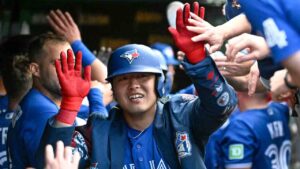
TORONTO – The Toronto Blue Jays introduced Kazuma Okamoto during a Jan. 6 news conference and as part of his visit to the city, the team planned a dinner for him at a high-end omakase sushi restaurant the next day. As the reservation approached, however, the newly signed slugger respectfully took a pass, because he’d gone to the Eaton Centre food court for lunch and crushed so many hot dogs he was too full for another meal.
A few months later, Okamoto’s diet went viral when he narrowly missed a three-homer game May 1 at Minnesota and blamed a ninth-inning drive falling short on not eating a pre-game quesadilla. “I think if I would have had that, it would have been a home run,” he said at the time. His taste for fast food may help explain why he got so stuffed during that initial stop at the Eaton Centre, but it’s also symbolic of the way the 30-year-old from Gojo, Japan, acclimated quickly to North America during a successful rookie season with the Blue Jays.
Okamoto crossed the Pacific as an established star with the Yomiuri Giants, with questions about how his game, especially his defence, would transfer to the majors.
After batting .232/.310/.452 with 33 homers and 92 RBIs while also playing third base better than the club expected, he proved he was up to the challenge, establishing the Blue Jays as a potential destination where Japanese position players can find success in the process.
“The 162 felt quick, actually, now looking back at it,” Okamoto said through interpreter Yusuke Oshima on the final day of the regular season. “But through ups and downs I learned a lot. It was a fun season.”
While Okamoto isn’t the first prominent Japanese player to play for the Blue Jays – Tomo Ohka, Munenori Kawaski, Nori Aoki, Shun Yamaguchi and, of course, Yusei Kikuchi all preceded him – he is the first everyday position player of prominence to make the jump.
Back in Tokyo, home of the Giants, “he is a superstar, he is known, he is that kind of guy,” agent Scott Boras said in a July interview. “He can't go out in the streets because he is a face.” That prominence meant every Blue Jays game this season received on-the-ground coverage from multiple Japanese media outlets, exponentially raising the franchise’s profile in the Land of the Rising Sun.
President and CEO Mark Shapiro said “the most easily quantifiable impact” of his addition is in the club’s social media engagement, but there’s also anecdotal evidence in “the number of Blue Jays hats that are now in Tokyo compared to what there were.” The team is examining ways to leverage that on the business-side, although as colleague David Singh covered earlier this year with a look at the Chicago Cubs, that takes time. Those efforts are ongoing, with the Blue Jays planning to send a marketing and corporate partners group over this off-season to build and expand relationships, and Shapiro possibly making a separate trip, too.
“We hope to have that be a part of our business strategy, as well, moving forward,” he said.
Of more immediate consequence, however, is the way Okamoto’s transition may be seen by a strong contingent of Japanese free agents the Blue Jays are expected to explore, led by the already established Seiya Suzuki of the Cubs, third baseman/outfielder Teruaki Sato and right-hander Kaima Taira.
Speaking in general terms, Okamoto said over the course of the season he’s chatted with players from back home and, “I was able to exchange some information and tell them what it's like in Toronto as well as the level of play here in MLB.”
Asked what he would say to free agents about life with the Blue Jays and Toronto, he replied, “I'll just be honest about how I felt about the team and the organization,” and he’s open to doing some recruiting if asked. “Of course I'd love to help out. I'll be honest, because it's obviously a big decision for them, not just baseball, but life as well.”
There are challenges for Japanese players in coming over both on and off the field and Boras believes they are more difficult for position players than pitchers. The adjustments begin with language and culture but extend down to not only the way the game is played, but the way it’s coached, too.
“The level of information given here far, far exceeds what they've been given there, so players tend to become technical rather than athletic,” explained Boras. “They play free all those years and they come here and they're loaded with all of the information that the tech, the coaches, and all of them in good faith, in good spirit, provide. The American players are used to hearing it. They're not.”
That can become amplified by being in a foreign environment, around players they likely don’t know, with rules and norms that are different. Boras recalled dealing with “the chill” of entering a new locker room for the first time when, as a double-A infielder in the St. Louis Cardinals system in 1977, he was traded to the Cubs and had to get to know his new teammates at Midland. “You don't know who you're talking to… everybody's watching you out of the corner of their eye,” he explained. “That 60-90 day period is another factor that leads to isolation.”
With Japanese players, “you can see an adjustment cycle that normally is not anywhere near as productive as they can be once they have that,” he continued. “It's easier for pitchers because pitchers get to go out and do something familiar. The information they're given is probably more precise and direct … and the pitching staff is dealing with a smaller group and you coalesce in a much easier form.”
Cognizant of the above, the Blue Jays worked to streamline the process for Okamoto.
They rehired Oshima, a Toronto native who was initially brought on to translate for Kikuchi and followed the left-hander to Houston and then Anaheim, to work as his interpreter. They already had Gosuke Katoh, the former big-league infielder, working with the coaching staff as an analyst, and Yuka Sanui, the big-league squad’s dietitian the past two years. Team leaders like Vladimir Guerrero Jr. and George Springer made a point of integrating him into the team dynamic from the day he arrived in Dunedin, Fla., for spring training.
And then “we pivoted pretty quickly to helping Kaz with the baseball stuff day-to-day, not just like the actual translating of it,” said manager John Schneider. “Having not just Yusuke but Gosuke, who played, talk through certain things, whether it was a fundamental play or whether it was kind of what a pitch might feel like, was really helpful for him.”
Okamoto praised the club’s resources and facilities for helping him acclimate quickly but also noted that “the transition always wasn’t the smoothest and there were some rough patches, too. But I've always believed in myself and always thought that I could hit here. It's great that I'm able to.”
Boras isn’t the least bit surprised.
“He's used to fame, he's used to expectation and he's used to the demands being placed on him as being the centre of something,” he said. “That's allowed him, I think, a shorter adjustment period, because he's so used to that. Basically, the Big Oak has many branches.”
As ever, the Blue Jays’ interest in NPB players will connect to the strengths of their current roster. Yet after a season in which they lacked both offence and starting pitching depth, that leaves a lot of possibilities open.
A bat would clearly help this team, with catcher, first base and third base the only positions that are definitively covered. That leaves open the possibility of Sato, the left-handed hitting 27-year-old who’s considered the top bat coming over from Japan. And starting pitching is more or less a constant need for contending teams, which means the Blue Jays are doing diligence on the top available NPB arms, too.
While Sato mostly played third base this season, he also has plenty of experience in the corner outfield, giving him Addison Barger-like versatility. But where Barger missed almost the entire season, Sato went off, hitting 39 home runs while posting an impressive .311/.389/.620 slash line.
Last winter’s contracts for Okamoto ($60 million, four years) and Munetaka Murakami ($34 million over two years) will be relevant reference points, but it’s possible Sato costs more than either given his youth and huge platform year.
On the pitching side, there are two established starters and at least one more name worth watching. Given their ongoing efforts in the Pacific Rim, the Blue Jays will of course be learning as much as they can about these three, among others.
Compact and explosive, Taira is perhaps the biggest name coming over this winter after posting a 1.36 ERA in 141 innings. Listed at five-foot-eight and 209 pounds, the 26-year-old Boras client is a former reliever who now touches 100 m.p.h. as a starting pitcher. With a wide arsenal of pitches, he’ll arrive in MLB as a starter and demand should be high.
While Taira might have the most upside, Hiromi Itoh shouldn’t be overlooked. The 29-year-old right-hander posted a 3.18 ERA in 172.2 innings this year, striking out 159 hitters. Also of note – he reached 150 innings for the sixth time in his six NPB seasons. That durability will appeal to teams, even if he doesn’t profile as a frontline arm.
Lastly, Kona Takahashi is another name to watch. The 29-year-old is an international free agent with no posting fee attached and is coming off a strong season in which he posted a 2.64 ERA in 143.1 innings. While he may be more of a depth contributor, there’s value in that kind of pitcher – especially when the MLB free agent class is far weaker than usual.
Irrespective of what the Blue Jays do this off-season, they must get more from what they already have in place. First and foremost in that regard is Guerrero, the MVP-calibre talent who suffered through a dreadful offensive season, but Okamoto is thinking about ways to get better in 2027, too.
In his first turn through majors, he noted that “obviously some pitchers have really good stuff that really wowed me,” and he pointed to his 183 strikeouts as something he didn’t expect.
“I’ve never struck out this much,” said Okamoto, whose previous career high was 132 strikeouts in 628 plate appearances, a 21 per cent rate, in 2019 with Yomiuri. “Going through that phase of striking out a lot was tough, but I’m always working hard to improve.”
Over the course of the season, he did that as through his first 83 games, he struck out 110 in 340 plate appearances, a 32.4 per cent clip, while over his last 73 outings, he struck out 73 times in 296 plate appearances, a 24.7 per cent rate, a reasonable trade-off for his .452 slugging percentage.
“This team is a very contact-oriented lineup, but we obviously talked about hitting for power, as well, with the coaches since spring training,” said Okamoto. “They reiterated the fact that they want me to hit for power and get off my A-swing every time. That's what I've been doing.”
The upcoming class of Japanese free agents may not get that far into the weeds of his numbers, but the process behind it and everything else that comes with the experience of playing in Toronto for the Blue Jays is sure to be noticed.
GM Ross Atkins described Okamoto’s transition as “just another demonstration that this is a good place to come and play baseball. We've got some attention, certainly from last year, some of our other pursuits and now a pretty significant impact on our team.”
Soon enough, the Blue Jays will see whether the next wave of Japanese stars agrees.




 0:56
0:56 0:43
0:43