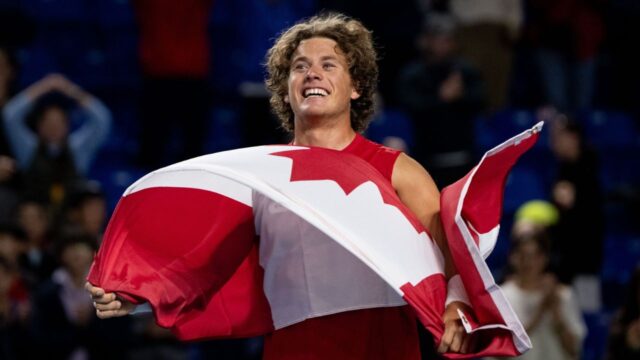
After missing the Finals last year, Canada is back in the last eight of the Davis Cup.
Led by Felix Auger-Aliassime, the Canadians kick off quarter-final festivities against Czechia on Tuesday as they look to capture the top prize of men’s international tennis for the first time since their historic 2022 championship.
Italy has won three consecutive Davis Cup titles dating to Canada’s victory. For the second straight year, Bologna will be the lone host city, and the Italians are well-positioned to win a fourth straight championship in front of home supporters as the top seed. Spain and Germany are also loaded with talent and primed to contend to end Italy's reign.
As for this iteration of the Canadian team, it is far from whole. Late withdrawals from Denis Shapovalov and Gabriel Diallo compromise Canada’s chances of making a deep run. On top of that, Auger-Aliassime has not played a competitive match in over a month due to injury, and will have to find his form against a world-class player.
Losing Shapovalov was a brutal blow for Canada. He and Auger-Aliassime were slated to lead the way as they did in 2022, but up-and-comer Liam Draxl will look to fill Shapovalov’s shoes.
The format, which was revamped in 2024, prioritizes singles over doubles. Each best-of-three tie begins with two singles matches followed by a deciding doubles match, if necessary.
In addition to Montreal's Auger-Aliassime and Draxl of Newmarket, Ont., Canada's roster also includes Alexis Galarneau (Laval, Que.), Duncan Chan (Markham, Ont.) and Keegan Rice (Regina).
There is no straightforward path for Canada, and to exceed expectations, a player like Draxl will have to outperform his ATP ranking.
Let’s look closer at Canada’s quarter-final tie with Czechia.
Canada vs. Czechia (Tuesday, 10 a.m. ET)
The Canadian and Czech hockey teams have had some heated battles in recent years, but this is the first time the nations have met in Davis Cup play.
Czechia boasts two top-15 singles players in Jiri Lehecka and Jakub Mensik, who are ranked Nos. 14 and 15, respectively. Spain is the only other team with two such players in the Finals.
Draxl, Canada’s likely second singles player with Auger-Aliassime, has never played Lehecka or Mensik. Auger-Aliassime and Mensik split their only two matches, with the 21-year-old Czech most recently upsetting Auger-Aliassime in the first round of the 2024 US Open. Lehecka and Auger-Aliassime have met four times, with the Canadian winning their last three matches, including a straight-sets victory in Dubai earlier this year.
Both Lehecka and Mensik are hard-hitting right-handers who play best on hardcourt. Level-wise, not much separates the two Czechs and Auger-Aliassime.
Despite being only one year younger than Auger-Aliassime, Draxl is at a much different phase of his career. A regular on the Challenger circuit, he is still looking to crack the top 100. He made a finals run at last week’s Drummondville Challenger.
Draxl seems to play his best tennis while donning the red and white. He is 4-0 in Davis Cup singles, most recently defeating France’s Arthur Rinderknech during the last round of qualifiers in Quebec City for the biggest win of his career.
An expressive player, Draxl constantly looks to get the crowd involved with screams and double-fist pumps. His ability to get the Italian fans on his side could play a role in his matches.
Knowing what Auger-Aliassime is capable of against the world’s top players, Draxl is Canada’s X-factor. If Canada can overcome Czechia, next up would likely be Italy, which is similarly front-loaded with singles talent. It’s hard to see Canada lifting the trophy without Draxl winning at least one singles match, and that would have to come against a superior opponent.
On the doubles front, Canada lacks a consistent tandem. Auger-Aliassime and Chan played together against France, but lost in straight sets. If he’s up for it after his singles match, Auger-Aliassime would likely be tasked to run doubles, either with Chan or Galarneau.
Czechia’s Patrik Rikl and Adam Pavlasek have loads of experience together, going 30-18 as a doubles tandem this year.
On almost all fronts in this quarterfinal matchup, it is advantage: Czechia. Captain Tomas Berdych is eager to lift a Davis Cup trophy for the first time since he led his country to back-to-back championships in 2012 and 2013.
But Canada was not heavily favoured in 2022, even with Shapovalov and Auger-Aliassime at the forefront. World tennis brings the best out of players who have not yet made a name on tour, and Draxl, as well as Rice and Chan, are champing at the bit to play hero for Canada.
Let’s take a quick look at the six other teams taking the court this week:
Italy vs. South Korea (Wednesday)
The heavy-underdog Koreans have a tall task ahead of them in Italy. For this tie to reach a decisive third match, a major upset would need to occur.
Led by Roland Garros finalist Flavio Cobboli, Italy has four formidable singles players, also including Lorenzo Musetti, Luciano Darderi and Matteo Berrettini, the latter of whom was a late addition after an injury-riddled season and will likely be used sparingly.
Korea upset Argentina in the first round of qualifying. It then beat India 3-1 in the last stage to book a date with the Italians. Soonwoo Kwan is Korea's top-ranked singles player (No. 160) and Jisung Nam stands out in doubles (No. 117).
Whether Italy goes with Darderi, Musetti or even Berrettini in the second match, it will be heavily favoured for a sweep.
Great Britain vs. Germany (Thursday)
This tie should be closely contested. Great Britain is looking to get back to the top for the first time since 2015, when it was led by Scottish superstar Andy Murray. In 24-year-old Arthur Fery, Great Britain has a budding star who became a household name after his semi-final appearance at Wimbledon. Fery and crafty southpaw Cameron Norrie will be relied upon to hold down the singles matches. Henry Patten and Neal Skupski round out the team as the highest-ranked doubles players in the finals field at Nos. 1 and 3, respectively.
Great Britain’s strategy should be simple: split the first two matches and let the doubles pairing carry the team over the finish line.
Alexander Zverev is the star of Germany’s show. The world No. 1, Zverev has been a regular Davis Cup fixture for Germany since 2016 and is looking to lead the nation to its first championship since 1993. Zverev won his first Grand Slam at Roland Garros in May, followed it up with a US Open title, and is on a mission to overcome prior shortcomings.
Jan-Lennard Struff, 36, has undergone a career renaissance in late 2026, and is a great second option for Germany.
Spain vs. Austria (Thursday)
Aside from Italy, no European country rivals Spain’s output of male tennis talent. Carlos Alcaraz is the face of Team Spain, and arguably the face of the sport.
The torch was passed to Alcaraz from the likes of Rafael Nadal and David Ferrer — the latter of whom captains Team Spain. A new Rafa — Rafael Jodar — has emerged with ferocity, finishing the year at No. 10 after entering 2026 outside the top 150.
Jodar, 20, and Alcaraz, 23, are ready to lead the next generation of Spanish tennis, and are the likeliest contenders to dethrone Italy.
Austria’s Neil Oberleitner and Lucas Miedler are experienced playing together, winning doubles titles this fall at the Vienna Open and Shanghai Masters. Without any top-100 singles options, the doubles pairing may never touch the court against Spain.
Interestingly, Austria has a favourable 3-2 record over Spain dating to 1933. However, four of the five meetings were pre-2000, before Spain established itself as a tennis powerhouse.